Are We Passive Observers or Powerful Creators?
visionary and mystic
n 1854, Chief Seattle warned the legislators in Washington,
D.C., how the destruction of North America’s wilderness had implications that would reach far beyond the current time and threaten the survival of future generations. With a profound wisdom that’s as true today as it was in the mid-19th century, the chief reportedly stated, “Man did not weave the web of life—he is merely a strand in it. Whatever he does to the web, he does to himself.”
The parallel between Chief Seattle’s description of our place in the “web of life” and our connection to (and within) the Divine Matrix is unmistakable. As part of all that we see, we're participants in an ongoing conversation—a quantum dialogue—with ourselves, our world, and beyond. Within this cosmic exchange, our feelings, emotions, prayers, and beliefs at each moment represent our
speaking to the universe. And everything from the vitality of our bodies to the peace in our world is the universe answering back.
WHAT DOES IT MEAN TO “PARTICIPATE” IN THE UNIVERSE?
As mentioned in the last chapter, physicist John Wheeler suggests that not only do we play a role in what he calls a “participatory universe,” but we fulfill the primary role. The key to Wheeler’s proposition is the word participatory. In this type of universe, you and [ are part of the equation. We’re both catalysts for the events of our lives, as well as the “experiencers” of what we create . . . these things are happening at the same time! We're “part of a universe that is a work in progress.” In this unfinished creation, “we are tiny patches of the universe looking at itselfi—and building itself.”?
Wheeler’s suggestion opens the door to a radical possibility: If consciousness creates, then the universe itself may be the result of this awareness. While Wheeler’s views were proposed later in the 20th century, we can’t help but think back to Max Planck’s 1944 statement that everything exists because of an “intelligent Mind,” which he called “the matrix of all matter.” The question that begs to be asked here is simply: What Mind?
In a participatory universe, the act of focusing our conscious- ness—of us looking somewhere and examining the world—is an act of creation in and of itself. We’re the ones observing and studying our world. We’re the mind (or at least part of a greater mind), as Planck described. Everywhere we look, our consciousness makes something for us to look at.
Key 5: The act of focusing our consciousness is an act of creation. Consciousness creates!
In our search to find the smallest particle of matter and our quest to define the edge of the universe, this relationship suggests that we may never find either. No matter how deeply we peer into the quantum world of the atom or how far we reach into the vastness of outer space, the act of us looking with the expectation that something exists may be precisely the force that creates something for us to see.
A participatory universe ... exactly what would that entail? If consciousness really creates, then how much power do we actually have to change our world? The answer may surprise you.
The 20th-century visionary from Barbados known simply by the name of Neville perhaps best described our ability to make our dreams a reality and bring imagination to life. Through his numerous books and lectures, in terms that are simple yet direct, he shared the great secret of how to navigate the many possibilities of the Divine Matrix. From Neville’s perspective, all that we experience—literally everything that happens to us or is done by us—is the product of our consciousness and absolutely nothing else. He believed that our ability to apply this understanding through the power of imagination is all that stands between us and the miracles of our lives. Just as the Divine Matrix provides the container for the universe, Neville suggested that it’s impossible for anything to happen outside the container of consciousness.
How easy it is to think otherwise! Immediately after the terrorist acts of September 11 in New York and Washington, D.C., the questions that everyone was asking were “Why did they do this to us?” and “What did we do to them?” We live during a time in history when it’s so easy to think of the world in terms of “them” and “us” and wonder how bad things can happen to good people. If there is in fact a single field of energy that connects everything in our world, and if the Divine Matrix works the way the evidence suggests, then there can be no them and us, only we.
From the leaders of nations whom we've learned to fear and hate to the people in other countries who touch our hearts and invite our love, we’re all connected in what may be the most intimate way imaginable: through the field of consciousness that’s
the incubator for our reality. Together, we create the healing or the suffering, the peace or the war. This could very well be the most difficult implication of what the new science is showing us. And it might also be the source of our greatest healing and survival.
Neville’s work reminds us that perhaps the biggest error in our worldview is to look to external reasons for life’s ups and downs. While there are certainly causes and effects that may lead to the events of every day, they seem to originate from a time and a place that appear completely disconnected with the moment. Neville shares the crux of the greatest mystery regarding our relationship to the world around us: “Man’s chief delusion is his conviction that there are causes other than his own state of consciousness.”* Just what does this mean? It’s the practical question that naturally arises when we talk about living in a participatory universe. When we inquire how much power we really have to bring about change in our lives and our world, the answer is simple.
Key 6: We have all the power we need to create all the changes we choose!
This capability is available to us through the way we use the power of our awareness and where we choose to place our focus. In his book The Power of Awareness, Neville offers example after example of case histories that clearly illustrate precisely how this works.
One of his most poignant stories has remained with me for years. It involves a man in his 20s who’d been diagnosed with a rare heart condition that his doctors believed was fatal. Married with two small children, he was loved by all who knew him and had every reason in the world to enjoy a long and healthy life. By the time Neville was asked to speak with him, the man had lost a tremendous amount of weight and “shrunk to almost a skeleton.”
He was so weak that even conversation was hard for him, but he agreed to simply listen and nod his understanding as Neville shared with him the power of his beliefs.
From the perspective of our participating in a dynamic and evolving universe, there can be only one solution to any problem: a change in attitude and in consciousness. With this in mind, Neville asked the man to experience himself as if his healing had already taken place. As the poet William Blake suggested, there’s a very fine line between imagination and reality: “Man is all Imagination.” Just as physicist David Bohm proposes that this world is a projection of events in a deeper realm of reality, Blake continues, “All that you behold, tho’ it appears Without, it is Within, / In your Imagination, of which this World of Mortality is but a Shadow.” Through the power of consciously focusing on the things that we create in our imagination, we give them the “nudge” that brings them through the barrier from the unreal to the real.
In a single sentence, Neville explains how he provided the words that would help his new friend accomplish his new way of thinking: “I suggested that in imagination, he see the doctor’s face expressing incredulous amazement in finding him recovered, contrary to all reason, from the last stages of an incurable disease, that he see him double-checking in his examination and hear him saying over and over, ‘It’s a miracle—it’s a miracle.’”> Well, you can guess the reason why I’m sharing this story: The fellow did get better. Months later, the visionary received a letter telling him that the young man had, in fact, made a truly miraculous recovery. Neville later met with him and found that he was enjoying his family and his life in perfect health.
The secret, the man revealed, was that rather than simply wishing for his health, since the day of their meeting, he had lived from the “assumption of already being well and healed.” And herein we find the secret of propelling our heart’s desires from the state of imagination to the reality of our everyday lives: It’s our ability to feel as if our dreams have already come to life, our wishes are fulfilled, and our prayers already answered.
In this way, we actively share in what Wheeler called our “participatory universe.”
Living from the Answer
There’s a subtle yet powerful difference between working toward a result and thinking and feeling from it. When we work toward something, we embark upon an open-ended and never-ending journey. While we may identify milestones and set goals to get us closer to our accomplishment, in our minds we're always “on our way” to the goal, rather than “in” the experience of achieving it. This is precisely why Neville’s admonition that we must “enter the image” of our heart’s desire and “think from it” is so powerful in our lives.
In the ancient study of martial arts, we see a beautiful metaphor in the physical world for precisely the way this principle works in consciousness. You’ve no doubt seen the demonstrations of people trained in these disciplines marrying their powers of concentration and strength into a single moment of intense focus where they’re able to perform a feat—such as breaking a concrete block or stack of boards—that would otherwise be impossible for them to achieve. The principle that allows for these displays is the same one that Neville described in his story of the young man’s healing.
While there are “tricks” that can sometimes be used in order to do these amazing feats without the spiritual emphasis, when they’re authentically performed, the key to success lies in where the martial artists place their attention. When they choose to break a concrete block, for example, the very last thing in their mind is the point of contact where their hand will touch the surface. Just as Neville suggested in his instruction to the dying man, the key is to put our focus in the place of the completed act: the healing already accomplished or the brick already broken.
Martial artists do this by centering their awareness on a point that’s beyond the bottom of the block. The only way their hand can be in this place is if they’ve already passed through the space
between them and that point. The fact that the space happens to be occupied by something solid, such as a concrete block, becomes almost secondary. In this way, they’re thinking from the point of completion, rather than about the difficulty of getting to there. They’re experiencing the joy of what it feels like to accomplish the act, as opposed to all the things that must occur before they can be successful. This simple example offers a powerful analogy for precisely the way consciousness seems to work.
I experienced this principle personally when I was in my early 20s. It was during that time that the center of my life turned away from working in a copper mill and playing in a rock band—and toward the spiritual focus of an inner power. On the morning of my 21st birthday, I suddenly and unexpectedly found myself drawn to the combination of long-distance running, yoga, meditation, and martial arts. I passionately began to pursue all four together, and they became the “rock” that I clung to whenever it seemed that my world was crumbling around me. One day in the dojo (the martial- arts studio) before our karate class began, I witnessed the power of a concentrated focus unlike anything that I’d ever seen growing up in the heartland of northern Missouri.
On that day, our instructor walked into the room and asked us to do something very different from the form and movement practices that were familiar to us. He explained that he would seat himself in the center of the thick mat where we honed our skills, close his eyes, and go into a meditation. During this exercise, he would stretch his arms out on either side of his body, with his palms open and facedown. He asked us to give him a couple of minutes to “anchor” himself in this T position and then invited us to do anything that we could to move him from his place.
The men in our class outnumbered the women by about two to one, and there had always been a friendly competition between the sexes. On that day, however, there was no such division. Together, we all sat close to our instructor, silent and motionless. We watched as he simply walked to the center of the mat, sat down with his legs crossed, closed his eyes, held out his arms, and changed his
breathing pattern. I remember that I was fascinated and observed closely as his chest swelled and shrank, slower and slower with each breath until it was hard to tell that he was breathing at all.
With a nod of agreement, we moved closer and tried to move our instructor from his place. At first, we thought that this was going to be an easy exercise, and only a few of us tried. As we grabbed his arms and legs, we pushed and pulled in different directions with absolutely no success. Amazed, we changed our strategy and gathered on one side of him to use our combined weight to force him in the opposite direction. Still, we couldn’t even budge his arms or the fingers on his hands!
After a few moments, he took a deep breath, opened his eyes, and with the gentle humor we’d come to respect, he asked, “What happened? How come I’m still sitting here?” After a big laugh that eased the tension and with a familiar gleam in his eyes, he explained what had just happened.
“When I closed my eyes,” he said, “I had a vision that was
like a dream, and that dream became my reality. I pictured two
mountains, one on either side of my body, and myself on the
ground between the peaks.” As he spoke, I immediately saw the
image in my mind’s eye and felt that he was somehow imbuing us
with a direct experience of his vision.
“Attached to each of my arms,” he continued, “I saw a chain
that bound me to the top of each mountain. As long as the chains
were there, I was connected to the mountains in a way that nothing
could change.” Our instructor looked around at the faces that were
riveted on each word he was sharing. With a big grin, he concluded,
“Not even a classroom full of my best students could change
my dream.”
Through a brief demonstration in a martial-arts classroom, this beautiful man had just given each of us a direct sense of the power to redefine our relationship to the world. The lesson was less about reacting to what the world was showing us and more about creating our own rules for what we choose to experience.
The secret here is that our instructor was experiencing himself from the perspective that he was already fixed in one place on
that mat. In those moments, he was living from the outcome of his meditation. Until he chose to break the chains in his imagination, nothing could move him. And that’s precisely what we found out.
In Neville’s words, the way to accomplish such a feat is to make “your future dream a present fact.”* In a nonscientific language that sounds almost too straightforward to be true, he tells us precisely how this is done. Please don’t be deceived by the simplicity of the visionary’s words when he suggests that all we need to do to transform our imagination into reality is to “assume the feeling of our wish fulfilled.”’ In a participatory universe of our making, why should we expect it to be difficult to have the power to create?
MANY POSSIBILITIES/ONE REALITY
Why would the way we think and feel about our world have any effect whatsoever on the events that play out in our lives? How does simply making our “future dream a present fact” change the course of events that are already under way? If it looks as if our world is barreling down the path toward a global war, for example, does that conflict really have to occur? When it seems as though our marriage is about to crumble or that we’re destined to live with a debilitating heath condition, does the outcome of these experiences have to happen as predicted?
Or is there another factor—one that’s often discounted—that may, in fact, play a powerful role in how we experience the things that have already been set into motion? Does life follow our predictions or meet our expectations? The key to living from the place where our imagination is already fulfilled and our dreams and prayers are already answered is to understand how the possibilities exist to begin with. And to do that we need to return briefly to the central discovery that quantum physics makes about our world.
Quantum physics has been hugely successful in describing the behavior of things that are smaller than the atom—so successful, in fact, that a set of “rules” has been created to describe what we
can expect to happen in this tiny invisible world. While the rules are few and simple, they can also sound strange as they describe the things that particles do at the subatomic level. They tell us, for example, that:
° The “laws” of physics are not universal, because on small scales things behave differently from the way they do in the everyday world.
e Energy can express itself either as a wave or a particle, and sometimes as both.
e° The consciousness of the observer determines how energy will behave.
As good as these rules are, however, it’s important to remember that the equations of quantum physics don’t describe the actual existence of particles. In other words, the laws can’t tell us where the particles are and how they act once they get there. They describe only the potential for the particles’ existence—that is, where they may be, how they might behave, and what their properties could be like. And all of these characteristics evolve and change over time. These things are significant because we’re made of the same particles that the rules are describing. If we can gain insight into the way they function, then maybe we can become aware of greater possibilities for how we work.
Herein lies the key to understanding what quantum physics is really saying to us about our power in the universe. Our world, our lives, and our bodies exist as they do because they were chosen (imagined) from the world of quantum possibilities. If we want to change any of these things, we must first see them in a new way—to do so is to pick them from a “soup” of many possibilities. Then, in our world, it seems that only one of those quantum potentials can become what we experience as our reality. In my karate instructor’s vision, for instance, he observed himself fixed
to the mat in a place in time—and he was . . . no one could move him.
Which of the many possibilities becomes real appears to be determined by consciousness and the act of observation. In other words, the object of our attention becomes the reality of our world. This is the area where Einstein himself had a problem with quantum theory, stating, “I think that a particle must have a separate reality independent of the measurements.”*® In this context, the “measurements” are the equivalent of the observer—us.
Key 7: The focus of our awareness becomes the reality of our world.
Clearly, our role in the universe is central to the question of why the quantum world works in the way that it appears to. This is precisely why it’s important first to understand the “what” of scientific observations so that we can understand how we may apply them in our lives.
The mystery of why we need two sets of rules to describe the world can be traced to an experiment that was first conducted in 1909 by Geoffrey Ingram Taylor, a British physicist. While the experiment is nearly a century old, its results are still the subject of controversy and uncertainty. Since the time of the original experiment, it’s been re-created a number of times. Each time the results are identical—and just as mind-boggling.
The experiment, called the “double-slit” experiment, involves projecting things such as quantum particles through a barrier that has two small holes in it and measuring the way that they’re detected after they come through the openings. Common sense suggests that when things start out on one side as particles, they would travel throughout the experiment in that form and end as
particles as well. The evidence, however, shows that something quite extraordinary happens at some point between the place where the particles begin and where they finish.
Scientists have found that when an electron, for example, passes through the barrier with only one opening available, it behaves in just the way we’d expect it to: It begins and ends its journey as a particle. In doing so, there are no surprises.
Barrier with one Target/Detector
opening A
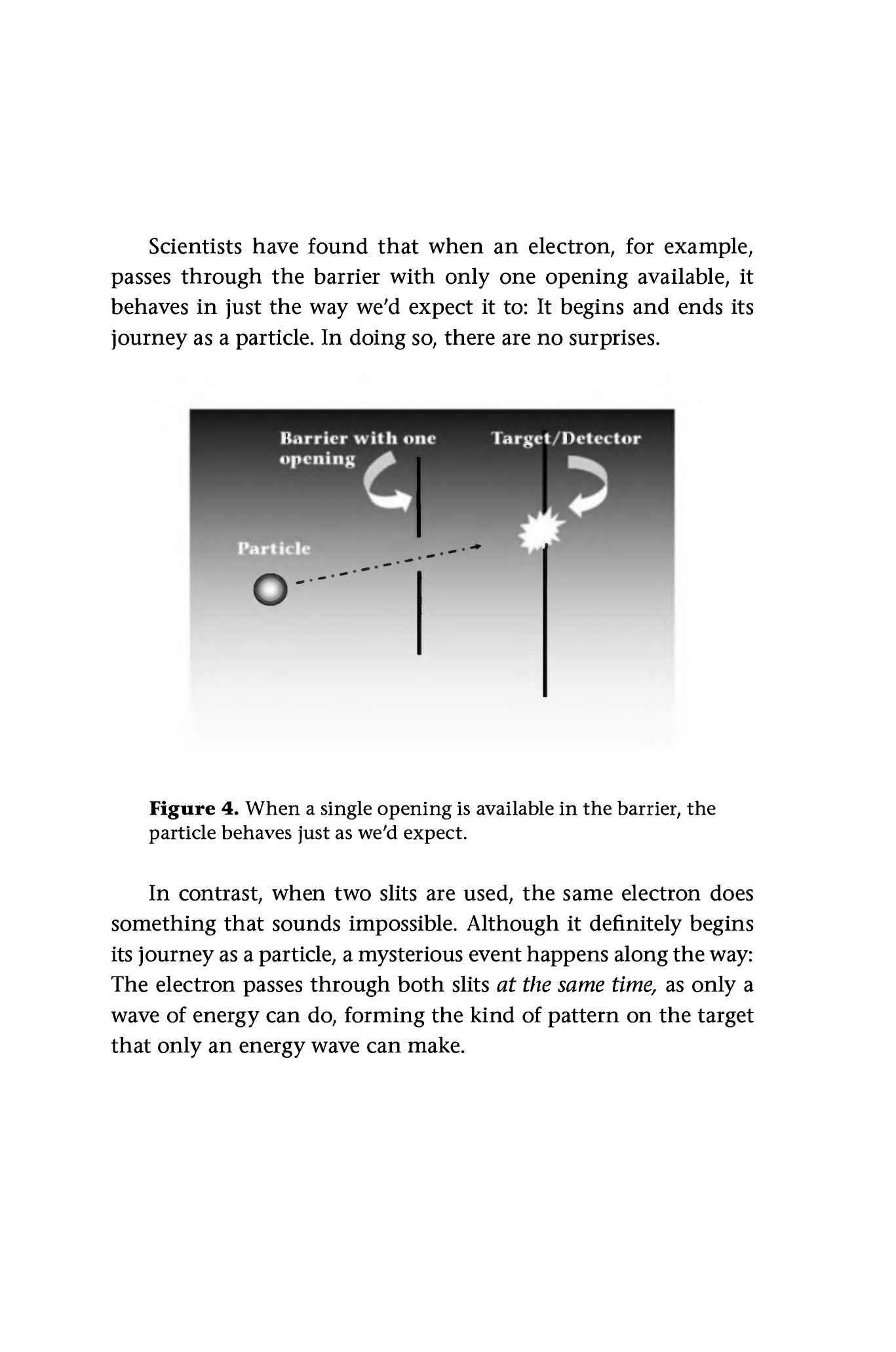
particle behaves just as we'd expect.
In contrast, when two slits are used, the same electron does something that sounds impossible. Although it definitely begins its journey as a particle, a mysterious event happens along the way: The electron passes through both slits at the same time, as only a wave of energy can do, forming the kind of pattern on the target that only an energy wave can make.
Barrier with two Target/Detector
openings
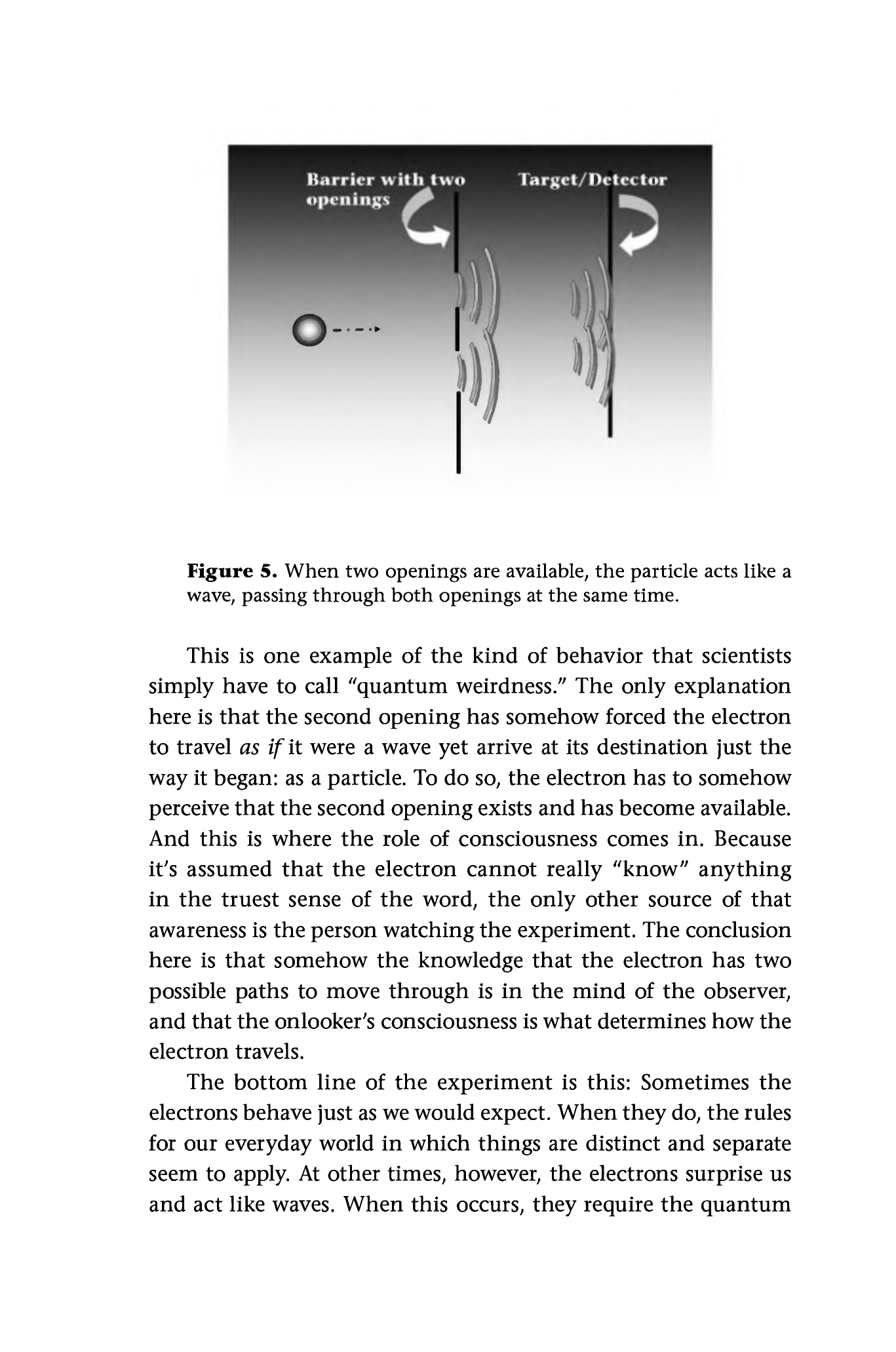
wave, passing through both openings at the same time.
This is one example of the kind of behavior that scientists simply have to call “quantum weirdness.” The only explanation here is that the second opening has somehow forced the electron to travel as if it were a wave yet arrive at its destination just the way it began: as a particle. To do so, the electron has to somehow perceive that the second opening exists and has become available. And this is where the role of consciousness comes in. Because it’s assumed that the electron cannot really “know” anything in the truest sense of the word, the only other source of that awareness is the person watching the experiment. The conclusion here is that somehow the knowledge that the electron has two possible paths to move through is in the mind of the observer, and that the onlooker’s consciousness is what determines how the electron travels.
The bottom line of the experiment is this: Sometimes the electrons behave just as we would expect. When they do, the rules for our everyday world in which things are distinct and separate seem to apply. At other times, however, the electrons surprise us and act like waves. When this occurs, they require the quantum
rules to explain their behavior. And this is where we have the opportunity to see our world and ourselves in a new light, because it means that we're a part of everything, and that consciousness plays a key role in the universe.
Historically, scientists look to one of two main theories to explain the results of the double-slit experiment. Each has its strengths and possesses certain aspects that make more sense than the other explanation. At the time of this writing, both are still theories, and a third possibility has been proposed more recently. Let’s take a brief look at all three interpretations.
THE COPENHAGEN INTERPRETATION
In 1927, physicists Niels Bohr and Werner Heisenberg at the Institute for Theoretical Physics in Copenhagen, Denmark, tried to make sense of the quantum weirdness that the new theories were revealing. The result of their work is known as the Copenhagen interpretation. So far, this is the most widely accepted explanation of why quantum particles act as they do.
According to Bohr and Heisenberg, the universe exists as an infinite number of overlapping possibilities. They’re all there in a kind of quantum soup with no precise location or state of being until something happens to lock one of the possibilities into place.
That “something” is a person’s awareness—the simple act of observation. As the experiment proves, when we look at something such as an electron moving through a slit in the barrier, the very act of observation is what appears to turn one of the quantum possibilities into reality. At that moment, all we see is the version that we’ve focused on.
Many Possibiliti
One Rea
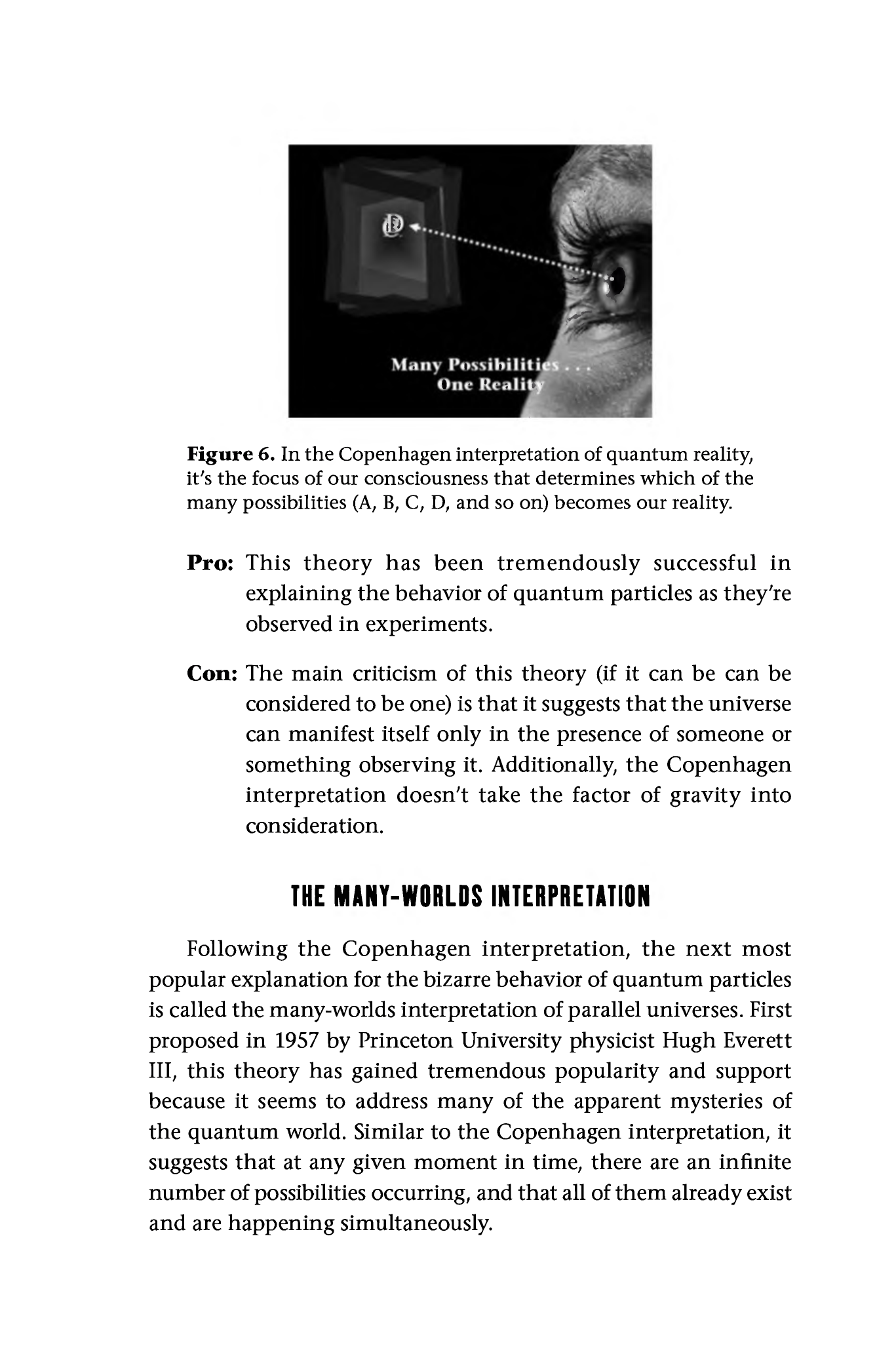
it’s the focus of our consciousness that determines which of the many possibilities (A, B, C, D, and so on) becomes our reality.
Pro: This theory has been tremendously successful in explaining the behavior of quantum particles as they’re observed in experiments.
Con: The main criticism of this theory (if it can be can be considered to be one) is that it suggests that the universe can manifest itself only in the presence of someone or something observing it. Additionally, the Copenhagen interpretation doesn’t take the factor of gravity into consideration.
THE MANY-WORLDS INTERPRETATION
Following the Copenhagen interpretation, the next most popular explanation for the bizarre behavior of quantum particles is called the many-worlds interpretation of parallel universes. First proposed in 1957 by Princeton University physicist Hugh Everett III, this theory has gained tremendous popularity and support because it seems to address many of the apparent mysteries of the quantum world. Similar to the Copenhagen interpretation, it suggests that at any given moment in time, there are an infinite number of possibilities occurring, and that all of them already exist and are happening simultaneously.
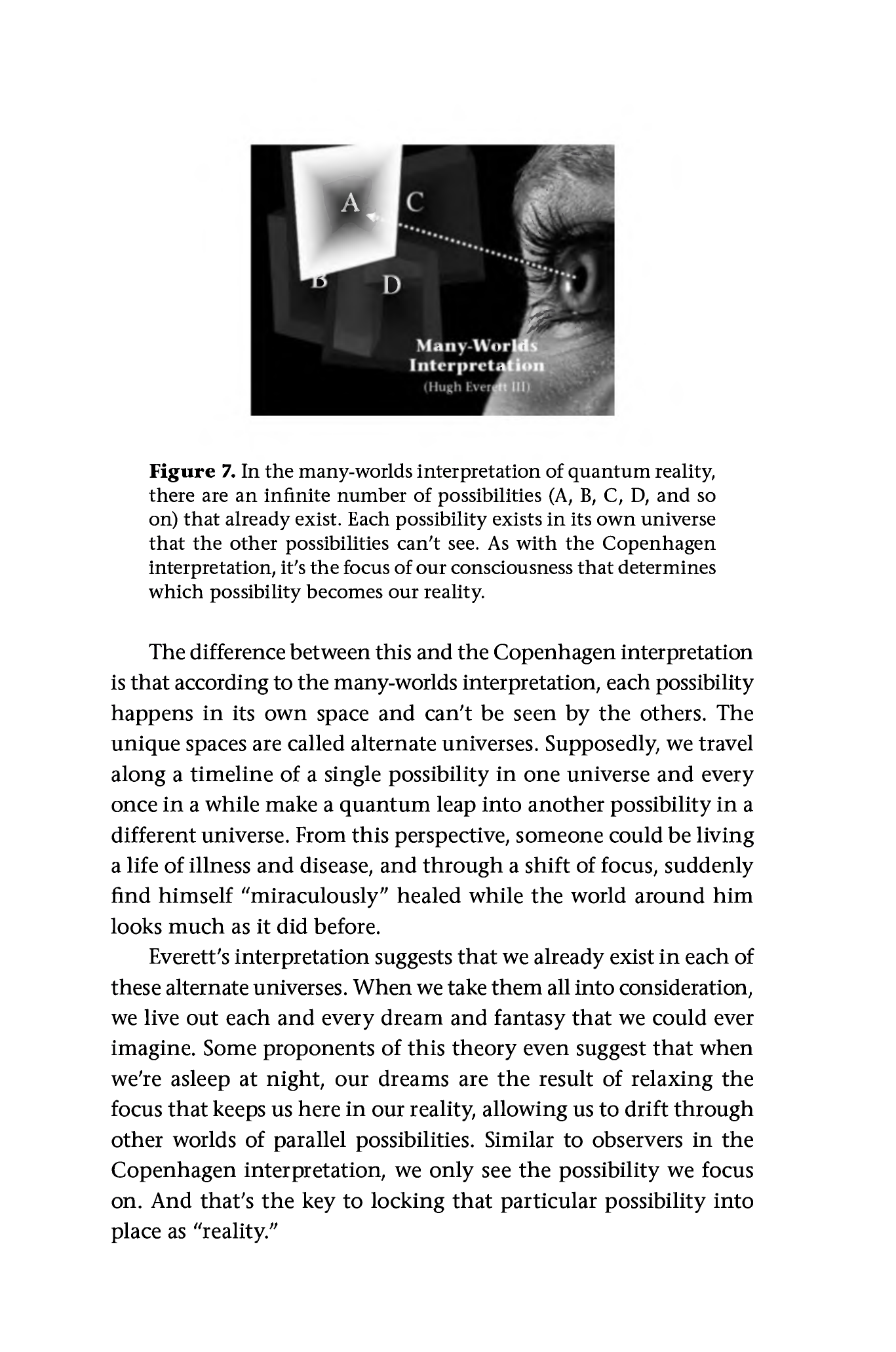
there are an infinite number of possibilities (A, B, C, D, and so on) that already exist. Each possibility exists in its own universe that the other possibilities can’t see. As with the Copenhagen interpretation, it’s the focus of our consciousness that determines which possibility becomes our reality.
The difference between this and the Copenhagen interpretation is that according to the many-worlds interpretation, each possibility happens in its own space and can’t be seen by the others. The unique spaces are called alternate universes. Supposedly, we travel along a timeline of a single possibility in one universe and every once in a while make a quantum leap into another possibility in a different universe. From this perspective, someone could be living a life of illness and disease, and through a shift of focus, suddenly find himself “miraculously” healed while the world around him looks much as it did before.
Everett’s interpretation suggests that we already exist in each of these alternate universes. When we take them all into consideration, we live out each and every dream and fantasy that we could ever imagine. Some proponents of this theory even suggest that when we're asleep at night, our dreams are the result of relaxing the focus that keeps us here in our reality, allowing us to drift through other worlds of parallel possibilities. Similar to observers in the Copenhagen interpretation, we only see the possibility we focus on. And that’s the key to locking that particular possibility into place as “reality.”
Pro: This theory seems to explain why we don’t see the many possibilities proposed by the Copenhagen interpretation.
Con: As with any of the ideas based on quantum theory, the theory can’t account for the force of gravity. Although it may explain some of what we see in the quantum world, until it can account for all of nature’s forces, it’s seen as incomplete.
In recent years, a third theory has been proposed, one that seems to address the shortcomings of both the Copenhagen and the many-worlds interpretations. Named after its author, Oxford University professor of mathematics Sir Roger Penrose, the Penrose interpretation suggests that the force of gravity that quantum physicists often dismiss is the very thing holding the universe together.
THE PENROSE INTERPRETATION
Similar to the proponents of the other interpretations, Penrose does believe that many possibilities or probabilities exist at the quantum level. His theory differs, however, as to what it is that “locks” one particular possibility into our reality.
Penrose proposes that the quantum possibilities of the other realms are a form of matter. Because all matter creates gravity, each of the possibilities has its own gravitational field. However, it takes energy to maintain this, and the more energy a probability requires, the more unstable it really is. Because it’s impossible to sustain enough energy to keep all of them going forever, eventually they collapse into a single state—the most stable one, which we see as our “reality.”
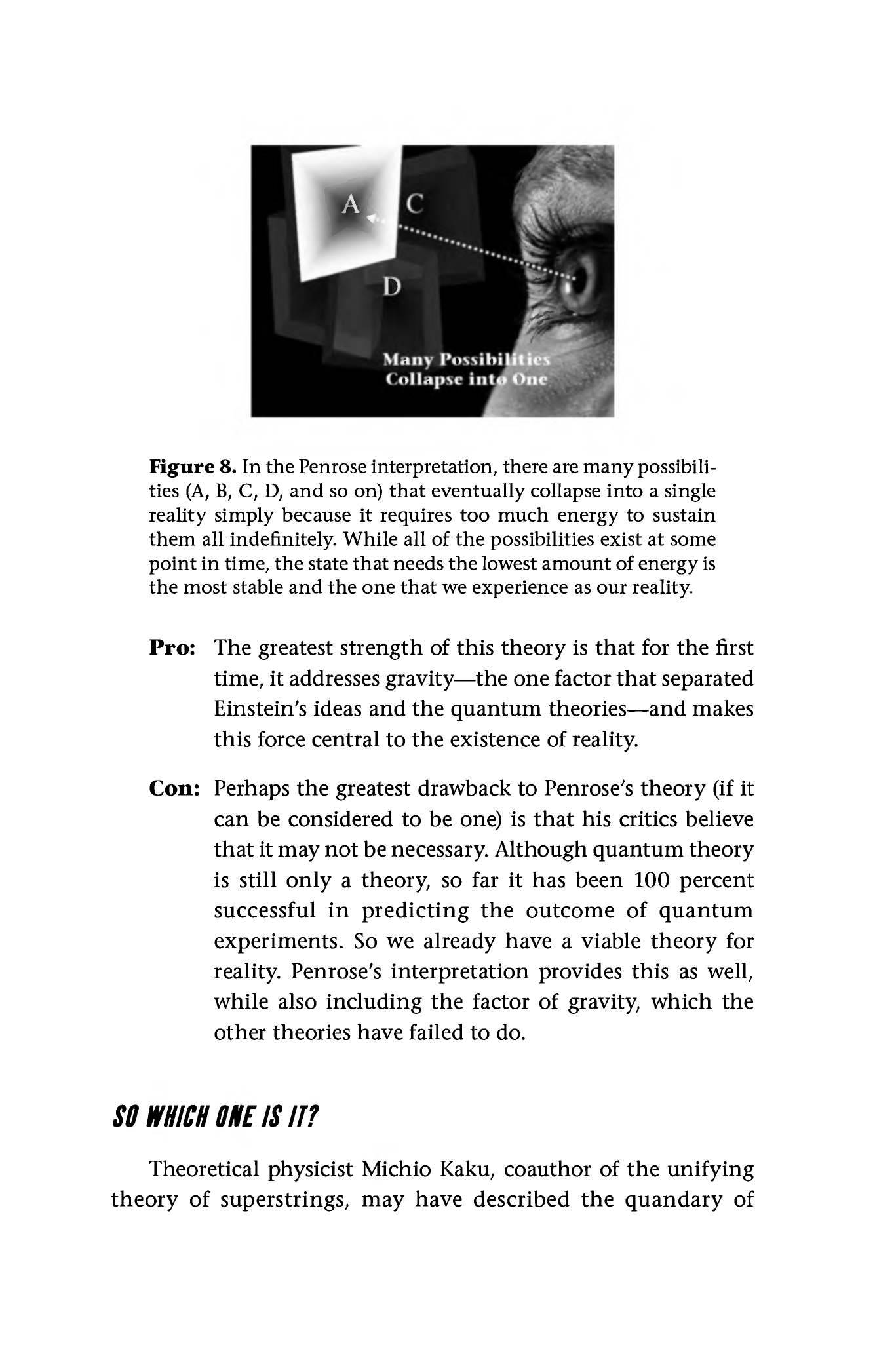
ties (A, B, C, D, and so on) that eventually collapse into a single teality simply because it requires too much energy to sustain them all indefinitely. While all of the possibilities exist at some point in time, the state that needs the lowest amount of energy is the most stable and the one that we experience as our reality.
Pro: The greatest strength of this theory is that for the first time, it addresses gravity—the one factor that separated Einstein’s ideas and the quantum theories—and makes this force central to the existence of reality.
Con: Perhaps the greatest drawback to Penrose’s theory (if it can be considered to be one) is that his critics believe that it may not be necessary. Although quantum theory is still only a theory, so far it has been 100 percent successful in predicting the outcome of quantum experiments. So we already have a viable theory for reality. Penrose’s interpretation provides this as well, while also including the factor of gravity, which the other theories have failed to do.
SO WHICH ONE IS IT?
Theoretical physicist Michio Kaku, coauthor of the unifying theory of superstrings, may have described the quandary of
quantum physics best when he said, “It is often stated that of all the theories proposed in this century, the silliest is quantum theory. Some say that the only thing that quantum theory has going for it, in fact, is that it is unquestionably correct.”®
Does one of the three prevailing theories explain both the “anomalous” events of the very small subatomic realm and why the world we see works as it does? As good as each interpretation is and as well as it may account for what we notice in the laboratory, the one factor that may be the “missing link” is the role that the Divine Matrix plays in connecting us with the container for all that’s observed.
While the onlooker seems to be the wild card in the experiments that produce the unexpected results, what if the “anomalies” aren't anomalies at all? What if the “weirdness” of quantum particles is actually the normal way that matter behaves? Is it possible that everything—from information traveling faster than the speed of light to two things existing in the same place at the same instant in time—is really showing us our potential, rather than our limitations? If so, then we have to ask ourselves: “What’s the one factor that links all these things together and prevents us from experiencing the same freedom that quantum particles seem to?”
We’re the precise factor that’s missing in the existing theories! Specifically, it’s our ability to purposefully create the conditions of consciousness (thoughts, feelings, emotions, and beliefs) that lock one possibility of our choosing into the reality of our lives. And this is what brings science full circle with the world’s ancient spiritual traditions. Both science and mysticism describe a force that connects everything together and gives us the power to influence how matter behaves—and reality itself—simply through the way we perceive the world around us.
The key is that there’s a big difference in the significance that various spiritual traditions and mainstream science give to the discoveries in the quantum world. For reasons that I described earlier, physicists for the most part believe that the way electrons
and photons behave has little to do with how we live our everyday lives. The ancient traditions, on the other hand, suggest that it’s because of the way things work on a subatomic level that we can change our bodies and the world. If this is true, then what happens in the quantum realm has everything to do with our day-to-day lives.
As my Native American friend Joseph suggested in the canyon, we don’t need machines to create the miraculous effects that we see in quantum particles. Through the power of our forgotten inner technology, we can heal, bilocate, be everywhere at once, remote- view, connect telepathically, choose peace, and do everything in between. It’s all about our power to focus consciousness, which is the great secret of some of our most ancient and cherished traditions.
REALITY-MAKING 101
In the teachings of Mahayana Buddhism, it’s believed that reality can exist only where our mind creates a focus. In fact, the wisdom suggests that both the world of pure form and that of the formless result from a mode of consciousness called “subjective imagination.””° While any experience certainly seems real enough to us, it’s only when we direct our attention while we're having a feeling about the object of our focus that a possible reality becomes that “real” experience. Except for a slight variation in the language, this ancient tradition sounds a lot like 20th-century quantum theory.
If all of the dos and don’ts of quantum possibilities are true and emotion is the key to choosing reality, then the question is: “How do we feel as if something has happened when the person next to us stares us squarely in the face and says that it hasn't?” For example, are we lying to ourselves if we say that a loved one is already healed while we're standing over that person in the intensive care unit of St. Someone’s Hospital?
The irony of this last question is that its very nature eludes
any single answer. In a universe of many possible realities, there are numerous potential answers. Somewhere among all those alternate realities there exists a scenario where our loved one’s healing has already happened. Someplace there’s a reality where the disease never even occurred. For reasons that we may never know or understand, however, this isn’t the outcome that’s been awakened—it’s not the reality that’s lying on the gurney in front of us.
The answer to our question boils down to what we believe about the world and our power to choose. The question then becomes: “Which possibility do we pick? Which reality does our loved one or the doctor decide on?” To answer this, we must first acknowledge that we have the power to make such a choice.
Just as Neville’s story of the man and his near-fatal illness demonstrated, the present reality isn’t set in stone. Rather, it appears to be soft and malleable; it can even change when it looks as if there’s no reason for it to do so. In Neville’s account, the young man’s doctors had made a diagnosis (picked a reality) with an expected outcome. Not knowing that he had a choice, the man initially believed them and bought into their version of reality. It was only when he was offered another possibility and he accepted it that his body responded to his new belief—and did so quickly. (I share another powerful example of such a possibility in Chapter 4.)
Einstein made a famous statement that we can’t solve a problem while we're in the same level of thinking that created it. Similarly, we can’t change a reality if we remain in the same consciousness that made it. To lock in one of the many possibilities described by the Copenhagen, many-worlds, and Penrose theories of reality, we must pinpoint it. And we do so through the way we “observe” it—that is, how we feel about it in our lives.
Once we recognize that we have a choice in terms of what we see as our reality, the next questions that are commonly asked are: “How do we do it? How are we to view someone as healed if the body of that person appears diseased?” The answer begins
with our willingness to look beyond the illusion of what the world is showing us. In the example of our loved ones’ illnesses, we're invited to see beyond the sickness that they’ve experienced, thinking about them as already healed and feeling what it’s like to be with them in this new reality.
To choose a different possibility, however, we must do more than just think about the new way of being or wish that the recovery of our loved one had already happened. This is perhaps the greatest caution in this way of seeing the world and the one that can present the greatest pitfall. In our fear of losing the people, places, and things that we hold most dear, there’s a temptation to deal with the magnitude of the situation by denying the reality that stares us in the face, simply saying that we don’t believe it. But unless we also take the actions that replace that frightening reality with one of healing, our nonacceptance is bound to produce little more than frustration and disappointment.
I’ve personally experienced the loss of friends who fell into this trap and are no longer in this world today. Although they’re the only ones who'll ever know what really happened in their hearts and minds before passing, I had the opportunity to witness some of the struggles they went through with their beliefs. “If I’m such a powerful being,” they reasoned, “then why do I still have this condition? I’ve changed my beliefs . . . why haven't I healed?”
The topic is deep, personal, and sensitive. And the answer can often bring up strong feelings in discussions about what “is,” how the universe seems to work, and where God fits in. The bottom line is this: There’s a fine and delicate balance between simply choosing a new possibility and actually following through with the thoughts, feelings, and beliefs that awaken that outcome as a new reality.
Key 8: To simply say that we choose a new reality is not enough!
To choose a quantum possibility, we must become that way of being. As Neville suggests, we must “abandon” ourselves to the new possibility and in our “love for that state .. . live in the new state and no more in the old state.”"? And that’s precisely what the ancient instructions found in some of our most cherished traditions invite us to do. The technique for this human-to-divine interface is often called prayer.
Speaking Quantum: Feeling is the Key
Earlier in this chapter we identified the various interpretations of why quantum weirdness seems to happen in the way that it does. The theories are particularly concerned with why the act of our simply observing matter seems to change it. While each explanation varied as to why the particular effect is happening, they all seem to suggest the same common denominator: us and our role as observers in the world.
When we observe something—that is, when we consciously focus our attention on one place in time—it appears that we’re locking one of the many quantum possibilities into place in that instant. Whether it’s coming from a “parallel reality” or from the soup of flickering quantum probabilities, the theories suggest that what we see as Reality (with a capital R) is what it is because of our presence.
While this appears to be revolutionary news to modern science, it’s been accepted as the way things are in ancient traditions and indigenous cultures for centuries. In the words of times past, scribes, mystics, healers, and scholars did their very best to preserve this great secret of our relationship to the universe and pass it on to us. Sometimes we find it in the places where we would least expect to encounter such powerful wisdom.
From the temple walls and tombs in the deserts of Egypt to the Gnostic wisdom of the ancient Nag Hammadi library to the traditional medicine practiced today throughout the American Southwest, the language that breathes life into the possibilities of
our imagination, dreams, and prayers remains with us. Perhaps the clearest example of this language is described in the words of aman who lived in a monastery nearly 15,000 feet above sea level, high on the Tibetan plateau.
In the spring of 1998, I had the opportunity to facilitate a combined research trip and pilgrimage into the highlands of central Tibet for 22 days. During that time, the group and I found ourselves immersed in some of the most magnificent, rugged, pristine, and remote land remaining on the planet today. Along the way, we visited 12 monasteries, 2 nunneries, and some of the most beautiful humans that you could ever imagine, including monks, nuns, nomads, and pilgrims. It was during that time that J found myself face-to-face with the abbot of one of the monasteries and got the chance to ask the question that we’d traveled so far and long to ask.
On an icy morning, we found ourselves cramped into a tiny chapel surrounded by Buddhist altars and ancient thangkas (the intricately brocaded tapestries that depict the great teachings of the past). I focused my attention directly on the eyes of the timeless-looking man seated lotus-style in front of me. Through our translator, I asked him the same question that I’d asked every monk and nun we'd met throughout our pilgrimage. “When we see your prayers,” I began, “what are you doing? When we watch you intone and chant for 14 and 16 hours a day; when we see the bells, bowls, gongs, chimes, mudras, and mantras on the outside, what’s happening to you on the inside?”
A powerful sensation rippled through my body as the translator shared the abbot’s answer. “You've never seen our prayers,” he said, “because a prayer cannot be seen.” Adjusting the heavy wool robes beneath his feet, the abbot continued, “What you've seen is what we do to create the feeling in our bodies. Feeling is the prayer!”
How beautiful, I thought. And how simple! Just as the late-20th- century experiments had shown, it’s human feeling and emotion that affect the stuff our reality is made of—it’s our inner language that changes the atoms, electrons, and photons of the outer world. However, this is less about the actual words we utter and more
about the feeling that they create within us. It’s the language of emotion that speaks to the quantum forces of the universe . . . feeling is what the Divine Matrix recognizes.
Key 9: Feeling is the language that “speaks” to the Divine Matrix. Feel as though your goal is accomplished and your prayer is already answered.
The abbot was telling us the same thing as the great scientists of the 20th century. Not only was he passing on the same ideas that the experimenters had documented, he was taking it one step further: He was sharing the instructions that describe how we can speak the language of quantum possibilities, and he was doing so through a technique that we know today as a form of prayer. No wonder prayers work miracles! They put us in touch with the pure space where the miracles of our minds become the reality of our world.
Compassion: a Force of Nature
And a Human Experience
The clarity of the abbot’s answer sent me reeling. His words echoed the ideas that had been recorded in ancient Gnostic and Christian traditions 2,000 years ago. For our prayers to be answered, we must transcend the doubt that often accompanies the positive nature of our desire. Following a brief teaching on overcoming such polarities, the words of Jesus recorded in the Nag Hammadi library remind us of the power of our commands. In words that should be familiar to us by now, we're reminded that when we say to the mountain, “Mountain move away,’ it will move away.”!?
Through the clarity of his words, the abbot answered the mystery of what it is the monks and nuns were doing in their prayers: They were speaking the quantum language of feeling and
emotion, one that has no words or outer expression.
In 2005, I had the chance to revisit the monasteries of Tibet for a total of 37 days. During the journey, our group learned that the abbot who’d shared the secret of feeling in 1998 had died. Although the circumstances were never made quite clear, we simply knew that he was no longer in this world. Even though we’d never met the man who took his place, when he heard of our return, he welcomed us back and allowed us to continue the conversation that began in 1998.
On another frosty Tibetan morning in a different chapel, we found ourselves face-to-face with the new abbot of the monastery. Only minutes before, we’d been led through the meandering stone- lined passageway that brought us to this tiny, cold, and dimly lit room—in absolute darkness, we'd carefully felt our way one step at a time along the slippery floor, which was dangerously smooth from centuries of spilled yak butter packed onto the surface. It was in the cool, thin air of the ancient room nestled in the heart of this monastery that J asked the new abbot my follow-up questions: “What connects us with one another, our world, and the universe? What’s the ‘stuff’ that carries our prayers beyond our bodies and holds the world together?” The abbot looked directly at me as our translator echoed my question in Tibetan.
Instinctively, I glanced to the guide, who was our go-between for the entire conversation. I wasn’t prepared for the translation that I heard coming back to me. “Compassion,” he said. “The geshe [great teacher] says that compassion is what connects us.”
“How can that be?” I asked, looking for clarity in what I was
hearing. “Is he describing compassion as a force of nature or as an
emotional experience?” Suddenly, an animated exchange broke out
as the translator put my question to the abbot.
“Compassion is what connects all things” was his final answer.
And that was it! Following nearly ten minutes of intensive dialogue
involving the deepest elements of Tibetan Buddhism, all I got to
hear was those six words!
A few days later, I found myself engaged in the same conversation once again, asking the identical question of a high-ranking monk
in another monastery. Rather than the formality we experienced in the presence of the abbot, however, we were in the monk’s cell—the tiny room where he ate, slept, prayed, and studied when he wasn’t in the great chanting hall.
By now, our translator was becoming familiar with the form of my questions and what I was trying to understand. As we huddled around the yak-butter lamps in the dimly lit room, I looked up at the low ceiling. It was covered with black soot from countless years of the same lamps burning for heat and light in the very place where we found ourselves on that afternoon.
Just as I’d asked the abbot only days before, I posed the same question (through the translator) to the monk: “Is compassion a force of creation, or is it an experience?” His eyes turned to the place on the ceiling where I’d been looking only seconds before. Taking a deep sigh, he thought for a moment, collecting the wisdom of what he’d learned since entering the monasteries at the age of eight. (He appeared to be in his mid-20s now.) Suddenly, he lowered his eyes, looking at me as he responded. The answer was short, powerful, and made tremendous sense. “It is both,” were the words that came back to me from the monk. “Compassion is both a force in the universe as well as a human experience.”
On that day, in a monk’s cell halfway around the world, nearly 15,000 feet above sea level and hours from even the nearest town, I heard the words of a wisdom that’s so simple many Western traditions have overlooked it to this day. The monk had just shared the secret of what connects us to everything in the universe, as well as the quality that makes our feelings and emotions so powerful: They’re one and the same.
Not Just Any Feeling Will Do
Recent translations of ancient prayers recorded in Aramaic, the language of the Essenes (the scribes of the Dead Sea Scrolls) seem to support precisely what the monk was sharing as the secrets of reality making. These new interpretations also offer fresh
clues as to why such instructions often appear to be so vague. By retranslating the original New Testament documents, it’s clear that tremendous liberties were taken over the centuries with the ancient authors’ words and intent. As the saying goes, a lot was “lost in the translation.” (I described this—and other examples that J share in these pages—in my last book, Secrets of the Lost Mode of Prayer, but they’re so relevant that I decided to include them here, too.)
Relating to our ability to participate in the events of life, health, and family, a comparison of the modern biblical version of “Ask and you shall receive,” for example, with its original text gives us an idea of just how much can be lost! The modern and condensed King James Version of the Bible reads:
“Whatsoever ye ask the Father in my name,
he will give it to you. Hitherto have ye asked
nothing in my name: Ask and ye shall
receive, that your joy may be full.”"*
When we compare this with the original text, we see the key that’s left out. In the following paragraph, I’ve emphasized the missing part by underlining it.
“All things that you ask straightly, directly . . .
from inside My name—
you will be given. So far you haven’t done this. . . .
So_ask without hidden motive and
be surrounded by your answer—
Be enveloped by what you desire, that your gladness be full.”
With these words, we're reminded of the quantum principle telling us that feeling is a language to direct and focus our consciousness. It’s a state of being that we’re in, rather than something that we do at a certain time of day.
While it’s clear that emotion is the language that the Divine Matrix recognizes, it’s also apparent that not just any feeling will
do. If it did, then the world would be a very confusing place, with one person’s idea of what should be overlapping with someone else’s very different conception. The monk stated that compassion is both a force of creation and the experience that accesses it. The deepest elements of the teaching suggest that in order to achieve compassion, we must approach a circumstance without a strong expectation of the rightness or wrongness of that situation’s outcome. In other words, we must perceive it without judgment or ego. And it appears to be precisely this quality of emotion that’s the key to speaking to the Divine Matrix in a way that’s meaningful and effective.
As the physicist Amit Goswami suggests, it takes more than a regular state of consciousness to make a quantum possibility a present reality. In fact, to do so he indicates that we must be in what he describes as a “non-ordinary state of consciousness.”'S
To get to this point, the Aramaic translation states that we must “ask without hidden motive.” Another way of clarifying this very important part of the instruction is to say in modern terms that we must make our decisions from a desire that’s not based in our ego. The great secret to bringing the focus of our imagination, beliefs, healing, and peace into a present reality is that we must do so without a strong attachment to the outcome of our choice. In other words, we're invited to pray without our judgments of what should or shouldn’t be happening.
Key 10: Not just any feeling will do. The ones that create must be without ego and judgment.
Perhaps one of the best descriptions of how we experience this neutral place is found in the work of the great Sufi poet Rumi. With words that are simple and powerful, he states, “Out beyond ideas of wrong-doing and right-doing there is a field. I’ll meet you
there.”'® How often can we truly say that we’re in Rumi's field of nonjudgment at any time in our lives—especially when the fate of our loved ones is hanging in the balance? Yet this appears to be precisely the greatest lesson of our power, the biggest challenge of our lives, and the enormous irony of our ability to create in a participatory universe.
It seems that the stronger our desire is to change our world, the more elusive our power to do so becomes. This is because what we want is so often ego based. If it weren't, the change wouldn't hold such significance for us. As we mature into the state of consciousness where we know that we can alter our reality, however, it also seems that it becomes less important for us to do so.
Similar to the way our desire to drive a car, for example, wanes after we actually begin to do so, in having the ability to work miracles of healing and peace, the urgency to make them happen seems to disappear. This may be because along with knowing that we can change things comes an acceptance of the world just the way it is.
It’s this freedom of possessing power without attaching so much importance to it that allows us to be even more effective in our prayers. And herein may lie the answer to the question asked by those who meditated, chanted, omed, danced, and prayed for the recovery of their loved ones.
Although every act was undoubtedly well intentioned, it often involved a strong attachment to having or making the healing of our loved ones happen. It entailed a belief that a miraculous recovery was necessary. And if the healing still needed to occur, the implication was that it hadn’t taken place yet—if it had, we wouldn’t be asking for it in our prayers. It’s as if by wanting the outcome of healing, the efforts to create it actually reinforced the reality that the disease was present! This leads to the second part of the ancient instruction, something that’s often overlooked in our attempts to bring miracles into our lives.
The next part of the translation invites us to “be surrounded” by our answer and “be enveloped” by what we desire so that our joy may come to pass. This passage reminds us in words of
precisely what the experiments and the ancient traditions suggest in their shared wisdom. We must first have the feeling of healing, abundance, peace, and the answers to our prayers of well-being in our hearts as if they’ve already happened before they become the reality of our lives.
In the passage, Jesus suggests that those he’s speaking with haven’t done that. Just like my friends with the powerful medicine of prayer and good intentions, while they may have believed that they asked for their prayers to be answered, if their request was simply the words Please let this healing happen, then he says that this isn’t a language that the universal field of the Divine Matrix recognizes. Jesus reminds his disciples that they must “speak” to the universe in a way that’s meaningful. When we feel as though we're surrounded by healing in our loved ones and enveloped by peace in our world, that’s both the language and the code that opens the door to all possibilities.
In this feeling, we move from the viewpoint that suspects we're simply experiencing whatever comes our way to the perspective that knows we're part of all that is. Thus, we create a shift of energy that may be described as the classic “quantum leap.” In much the same way that an atom’s electron jumps from one energy level to another without moving through the space between, when we really know that we're speaking the quantum language of choice and not simply thinking that we might be, we’re in another state of consciousness. It’s this state that becomes the pure space where dreams, prayers, and miracles begin.
WERE WIRED 10 CREATE
During a conversation with the Indian poet and mystic Rabindranath Tagore in 1930, Albert Einstein summarized the two viewpoints of the early 20th century regarding our role in the universe. “There are two different conceptions about the nature of the universe,” he began. The first sees “the world as a unity dependent on humanity,” and the second perceives “the world as a
reality independent of the human factor” [author’s italics].1” While the experiments described in Chapter 2 certainly show that our conscious observation of the stuff our world is made of, including atoms and electrons, directly affects the way that matter behaves, we'll probably find that there’s a third possibility—one that falls somewhere between Einstein’s two extremes.
This possibility may show that our universe came into existence through a process that didn’t involve us initially. Although creation could have started without our presence, we’re here now as it continues to grow and evolve. From the stars so distant that their lives are over before their light ever reaches our eyes to energy that’s disappearing into the mysterious vortices we simply call “black holes,” change is the universal constant that we can count on. It’s happening as part of everything we see and even in the realms we don’t.
By nowit should be clear that it’s impossible for us to be simply bystanders in our world. As conscious observers, we're part of all that we see. Additionally, although scientists have yet to agree upon which theory explains the way we change our reality, they all suggest that the universe is altered in our presence. It’s as if being conscious is an act of creation unto itself. As physicist John Wheeler stated, we live in a “participatory” universe—not one where we manipulate or force our will or are able to completely control the world around us.
In our capacity as part of the universe today, we have the ability to modify and change little pieces of it through the way we live our lives. In the realm of quantum possibilities, we appear to be made to participate in our creation. We're wired to create! Because we appear to be universally joined on the quantum level, ultimately our connectedness promises that the seemingly little shifts in our lives can have a huge influence on our world and even the universe beyond. Our quantum link with the cosmos runs so deep that scientists have created a new vocabulary to describe what such connections really mean. The “butterfly effect” mentioned in Chapter 1, for example, describes how small changes can have really big effects.
Formally known as sensitive dependence on initial conditions, the bottom line of this phenomenon suggests that a single small change in one part of the world can be the trigger for a huge alteration in another place and time. It’s most often stated as the analogy “If a butterfly flaps it wings in Tokyo, then a month later it may cause a hurricane in Brazil.”!* An often-used example of this effect is the result of a turn down the wrong street by Archduke Ferdinand’s driver in 1914. This mistake brought the leader of Austria face-to- face with his assassin, and history shows that Ferdinand’s death was the catalyst that led to World War I. It all began with the chance occurrence of a simple error that we've all made at one time or another. That wrong turn, however, had global consequences.
In Chapter 2, we explored three experiments that told the story of our relationship to the world around us. They showed us that DNA changes the stuff our world is made of and that emotion alters the DNA itself. The military experiments and those conducted by Cleve Backster demonstrated that this effect isn’t limited by time or distance. The net result suggests that you and I direct a force within us that works in a realm that’s free from the limits of physics as we know them.
The studies imply that we aren’t bound by the scientific laws as we understand them today. This may be precisely the power that the mystic St. Francis alluded to more than 600 years ago when he said, “There are beautiful and wild forces within us.”
If there’s a power within us to alter the essence of the universe in ways that can heal and create peace, then it makes tremendous sense that there would be a language that allows us to do so consciously and at will. And there is—interestingly, it’s precisely the language of emotion, imagination, and prayer that was lost to the West through the Christian church’s biblical edits of the 4th century.
When the Miracle Stops Working
The effects of the mind-body connection and certain kinds of prayer are well documented in the open literature. From studies in major universities and field tests in war-torn countries, it’s clear that the way we feel within our bodies affects not only us, but the world beyond.” This relationship between our inner and outer experiences appears to be the reason some forms of prayer empower us as they do. While the precise mechanism that explains why prayers work may not be fully understood, they do and the evidence is there. However, there’s also a lingering mystery. In the studies, the positive impact of the prayers seems to last only for the period of time that they’re occurring. When they stop, their effects also seem to end.
For example, during experiments in prayers for peace, the studies clearly show that there were statistically significant declines in the key indicators that the researchers were observing. The incidence of traffic accidents, hospital emergency-room visits, and even violent crimes against people went down. In the presence of peace, all that could happen was peace. As interesting as these results are, however, what they demonstrate next has been an ongoing mystery to those studying this effect.”°
When the experiments stopped, the violence returned, in some instances reaching levels even greater than before the experiments began. What happened? Why did the effects of the meditations and prayers appear to end? The answer to these questions may be the key to understanding the quality of awareness that creates. What happened was that the trainees stopped what they were doing—they ceased their meditations and prayers. And this is the answer to our mystery.
If we believe that choosing our reality is something that we do only for the moment, then it makes perfect sense that when we stop feeling as if our new reality exists, the effect of our decision is over as well. Our reality making may be a short-lived choice if we assume that feelings of healing, peace, and abundance are experiences that only last for minutes at a time. Between the modern experiments
and the instructions in ancient texts, we know that reality making is more than what we do .. . it’s what we are!
Key 11: We must become in our lives the things that we choose to experience as our world.
If feeling is the way we choose and we're feeling all the time, then we're also constantly choosing. We can feel our gratitude for the peace in our world with conviction because it always exists somewhere. We can feel appreciation for the well-being of our loved ones as well as ourselves because we're healed and renewed to some degree every day.
This may be precisely what the Aramaic versions of the Gospels were trying to convey to the people of the future through the language that they left for us nearly 2,000 years ago. It may be this very effect that’s described in the Gnostic text of the lost Gospel of Thomas, as well: “That which you have will save you if you bring it forth from yourselves. That which you do not have within you [will] kill you if you do not have it within you.””"
Although the admonition is brief, the implication is powerful. Through the words attributed to the master, Jesus, we’re reminded that the power to shape our lives and world is something that lives inside of us as an ability that we all share.
Life Doesn't Always Follow the Rules of Physics
What happens if we live in a way that breaks the accepted rules of physics? Or what if we don’t even know the rules exist? Is it possible that we can follow the example of quantum particles that seem to do precisely this?
Common sense tells us that if something exists in one location, then it certainly can’t be somewhere else at the same time,
regardless of what “it” is. Yet that’s precisely what the experiments have shown.
The obvious question that follows such discoveries is: If the stuff that the world is made of can be in two places at once and we're part of the world, then why can’t we do the same thing? Why can’t we fulfill our duty in the workplace or classroom and at the same time be enjoying ourselves on a sunny beach or hiking through a mountain canyon somewhere? While we've all wondered from time to time if such a thing could occur, the possibility is really just pure fantasy . . . isn’t it?
When we hear of something unusual happening on many occasions involving different individuals, there’s normally some truth to the reports. While the specifics may vary, it’s often possible to trace the underlying theme to an actual event in time. The Great Flood is a perfect example of what I mean here. Throughout history and in a multitude of cultures, there’s an almost universal theme that’s recounted time and again. Playing out on various continents, in diverse languages, and with different people, the story and the outcome are nearly identical.
Although the details vary, history is similarly punctuated with reports of people who’ve bilocated—that is, they physically appeared in different locations at the same instant in time. Often these feats are attributed to yogis, mystics, or individuals who have in some way mastered a dormant ability (not always, however). The common thread that seems to link these reports is that those who do the bilocating are generally masters of the power of human emotions such as love and compassion. Frequently, the reports are associated with the holy works of saints and are well documented by missionaries, native peoples, and others who are believed to be reliable witnesses to the miracles.
Among the best documented of the many instances of bilocation attributed to St. Francis of Paola, for example, was a case that happened in 1507. As the holy man was fulfilling his duties at the church altar, people who had come to see him found that he looked as if he was in a deep state of prayer, and they decided not to disturb him. When they left, however, they were more than
surprised to find him outside of the church they'd just entered. And he wasn’t simply standing there alone; he was talking with locals and those passing by on the street. Quickly, they ran back into the chapel, only to find that he’d never left—he was still there, “lost in prayer.” Somehow, through a mysterious state of consciousness associated with a deep meditative state, St. Francis of Paola had appeared to the same people in two locations during the same period of time.
Between 1620 and 1631, Maria de Agreda, a nun who lived for 46 years in a convent in Agreda, Spain, reported more than 500 journeys across the ocean, away to a distant land. As far as those who knew her and lived with her were concerned, she never once left the convent. For Maria, however, she would “fly” to the faraway place she spoke of during what she called her “experiences of ecstasy.”
Such a phenomenon could be chalked up today to a 300-year- old report of remote viewing (the ability to witness and perceive events from a distance by directing consciousness to a precise location), except for one curious distinction: Maria de Agreda not only visited the lands that she described, but she taught the indigenous people she encountered there about the life of Jesus. Although she spoke only her native Spanish, the Indians could understand her as she shared the teachings of the great master with them.
The documentation of her sightings came when the archbishop of Mexico, Don Francisco Manzo y Zuniga, heard about her experience. When he sent missionaries to investigate, they were amazed to find that the local Indians of the area were already well educated in the life of Jesus—so well, in fact, that they immediately baptized the entire tribe on the spot.
Nearly a decade later, Maria de Agreda’s mystical journeys were finally validated. While she was under a church-ordered oath of obedience, she described the intimate details of a land that she’d never physically visited. Her description was so complete that she included the subtleties of climate and changing seasons, as well as nuances of the culture and the beliefs of the people whom she’d
taught. Following a “rigorous ecclesiastical examination,” Maria de Agreda’s mystical journeys were declared by the church to be authentic and she was given the consideration of “the highest rank among the mystics of past ages.”
Not all reports of bilocation are from the murky years of the 16th and 17th centuries. As recently as World War II, there have been many instances of holy men appearing in multiple places at once. One of the best documented is that of Italy’s mystical Padre Pio. Following his promise that the Nazi-occupied city of San Giovanni Rotondo would be spared from destruction by the Allies, he appeared in broad daylight in a way that’s rare even for bilocation.
As the bombers arrived over the city to target German strongholds, the image of Padre Pio in brown robes appeared in front of their planes, hovering in midair! Unlike the brief apparitions that are sometimes reported under the stress of battlefield conditions, the image lingered for all to see. And as long as it remained, any attempt to release bombs on the city failed.
Frustrated and mystified, the pilots changed course and landed their planes at a nearby airfield with all of the bombs that were with them when they began their mission. Shortly afterward, one of the pilots went to a nearby chapel. To his amazement, inside of it he found the same friar that he’d seen earlier hovering in front of his plane. . . it was Padre Pio!
The padre wasn’t a ghost or the apparition of a long-deceased saint, as the pilot had suspected. He was real. He was alive. And on that day, he’d somehow been in two places at the same time: on the ground in the chapel and in the air directly in front of the planes. While the Allies liberated Italy, the city of San Giovanni Rotondo was spared, just as Padre Pio had promised.”°
When we experience something that appears to happen beyond the realm of what we know to be true, we often credit it as a miracle. So what are we to make of the reports and documented cases of bilocation and other seemingly miraculous feats that span more than 600 years? Can we write them off as pure fantasy or wishful thinking? . . . Possibly. There’s always the chance that they were
conjured up by people with too much time on their hands or who honestly wanted them to be true.
However, what if there’s something more happening here? If it’s proven to us beyond any doubt that we aren’t limited by the current laws of physics, that confirmation allows us to see ourselves in a powerful new light by offering us something beyond faith upon which to base our new beliefs.
Just as the initiates mentioned in the poem in the Introduction to this book found a new freedom in their unexpected experiences, if we find that we can follow in the “footsteps” of quantum particles that operate beyond the boundaries of space and time, then we can certainly use our ability to heal our bodies and bring joy to our lives. The key is this: To do what seems to be impossible, one person first has to push the limits of what we previously thought to be true. Just as the initiates discovered that they were more than they’d formerly believed once they moved beyond their fear of “the edge,” in order to live miracles in our lives, we must first overcome our beliefs that such phenomena are impossible.
Key 12: We are not bound by the laws of physics as we know them today.
For us to do so, someone must perform that miracle first so that we can see it happen. Maybe that person is particularly gifted in one area of life, such as healing. Or perhaps that individual simply has the openness to see the world differently. Regardless of how it happens, once one person does that special something—whether it’s Jesus or your next-door neighbor—then the same miracle becomes available to everyone else.
A beautiful example of this principle is illustrated by the inability of the native peoples of North America to see the ships of the early Europeans that were anchored just off their shores. The concept of a massive wooden boat with huge masts and sails was so
foreign to them that they had no point of reference for what they were seeing. In the same way that our vision is capable of detecting the individual frames of a movie, the natives’ eyes could certainly make out the silhouette of the ships on the horizon. And just as our brains try to make sense of what we see by merging the frames together into the continuous experience of the movie, the natives tried to do the same thing. The problem was that no one had ever done it before: Nothing in their collective experience told them how to see a European sailing vessel.
It was only when the medicine man of the tribe squinted and used his vision a little differently that he could begin to make out the ships. Once he did, it wasn’t long before everyone in the group was able to see what only hours before had been invisible. It was all about the way the people allowed themselves to perceive. In their willingness to try something different, a whole new world opened up to them. Maybe we’re not so different from those natives on the shore a little more than 500 years ago. We can only imagine what’s in store for us when we think of our world, our universe, and ourselves a little differently.
At the beginning of this section, we asked the question “If an electron is able to be in two places, why can’t we?” Perhaps the answer could be found if we posed our query a little differently. Rather than buying into the belief that particles can do something that we can’t, let’s ask what it takes for an electron to bilocate. If we understand how the stuff we’re made of behaves under the circumstances of a miracle, maybe we can find those conditions in our own lives. And to understand how this works, we’ll need to explore the single facet of our existence that gives each of us the ability to alter our world by changing ourselves: the power of the hologram.