Rewriting the Reality Code: 20 Keys to Conscious Creation
20 KEYS 10 CONSCIOUS CREATION
“You have now found the conditions
in which the desire of your heart can
become the reality of your being. Stay
here until you acquire a force in you
that nothing can destroy.”
— Spoken to the mystic
Gurdjieff by his teacher
in Meetings with Remarkable Men:
Gurdjieff’s Search for Hidden Knowledge’
he words of a popular ’70s rock ballad by the group Ten Years
After echo the same heartfelt desire that I’ve heard from people throughout the world who desperately want to make a difference and yet feel helpless to do so. “I’d love to change the world,” the chorus begins, “But I don’t know what to do / So I'll leave it up to you.”” My hope is that in the pages that follow, we’ll weave together everything we need for the instructions to empower ourselves with the knowledge to create a better world.
In the first chapter of this book, I shared the story of my Native American friend and how the people of his tradition believe that we mysteriously began to forget our power to change the universe long ago. He suggested that the complex technology being used today is our attempt to remember this ability by mimicking in our world what we can actually do in our bodies. With this in mind, it’s not surprising that computers have become such an integral part
of our lives: They do in fact appear to mimic the way we store our memories and communicate with one another.
The comparison of inner versus outer technology may go even further than my friend suspected, however (or at least further than he shared with me on that day). In many ways, our brains and even consciousness itself have been compared to the way a modern computer works. In his groundbreaking book Consciousness Explained, Daniel Dennett, director of the Center for Cognitive Studies at Tufts University, says that we can actually think of our brains “as a computer of sorts,” and that doing so gives us a powerful metaphor to understand how we use information.’ In many ways, the ideas of computer science give us just what we need to find our way in what he calls the “terra incognita,” or the unknown land, between what science tells us about the brain and what we experience through it. Clearly, the success of the computer as a tool of memory and communication gives us a powerful analogy to help us understand the mystery of consciousness.
Following is a brief description of how a modern computer works. Although tremendously oversimplified, the information is accurate. This simple model will allow us to compare our outer world of hardware and software to the inner workings of consciousness itself. The parallels are fascinating, and the similarity is unmistakable.
To begin with, all computers need only three things to make them useful. Regardless of how big or small or how complicated a computer may look, it will always need hardware, an operating system, and software to perform. So far, this sounds simple enough . .. but to shed a new light on consciousness, it’s important to understand just what these three parts of a computer really do.
The operating system is what makes it possible for us to communicate with our computer’s chips and circuits, and ultimately make something happen on the printer, screen, and so forth. Whether it’s the familiar Macintosh or Windows operating systems, or even the more exotic ones developed for special tasks, when we type our commands into the keyboard, it’s because of this
operating system that they make sense to the computer. It translates our instructions into something that the machine recognizes.
The hardware is the physical structure of the computer itself. It includes things such as the monitor and keyboard, as well as the circuits, chips, and processors—the gadgets through which the operating system works. The output of a computer’s work is typically made visible on some kind of hardware device. In addition to the screen, this may include the printers, plotters, and projectors that display what we've created.
The software includes the familiar programs such as Word, PowerPoint, and Excel that we use every day in our offices and schools to get our jobs done. It’s through our interface with these programs that the computer receives the commands from us that make the whole thing useful!
Here’s the key to this analogy: For all intents and purposes, the operating system of a computer is fixed and doesn’t change. In other words, it “is” what it is. When we want to see our computer do something different, we don’t change the operating system—we change the commands that go into it. The reason why this is important is that consciousness appears to work in precisely the same way.
If we think of the entire universe as a massive consciousness computer, then consciousness itself is the operating system, and reality is the output. Just as a computer’s operating system is fixed and changes must come from the programs that speak to it, in order to change our world, we must alter the programs that make sense to reality: feelings, emotions, prayers, and beliefs.
~~~
Function Electronic Computer Consciousness Computer
Hardware CPU, Screen Printer, etc. Reality (The Divine Matrix)
Operating System XP, Windows, Macintosh Consciousness
Programs (software) Word, Excel, PowerPoint Feelings, Emotions, Prayer, Beliefs
To change our reality, we must change the commands of Feeling, Emotion, Prayer, and Belief that program reality.
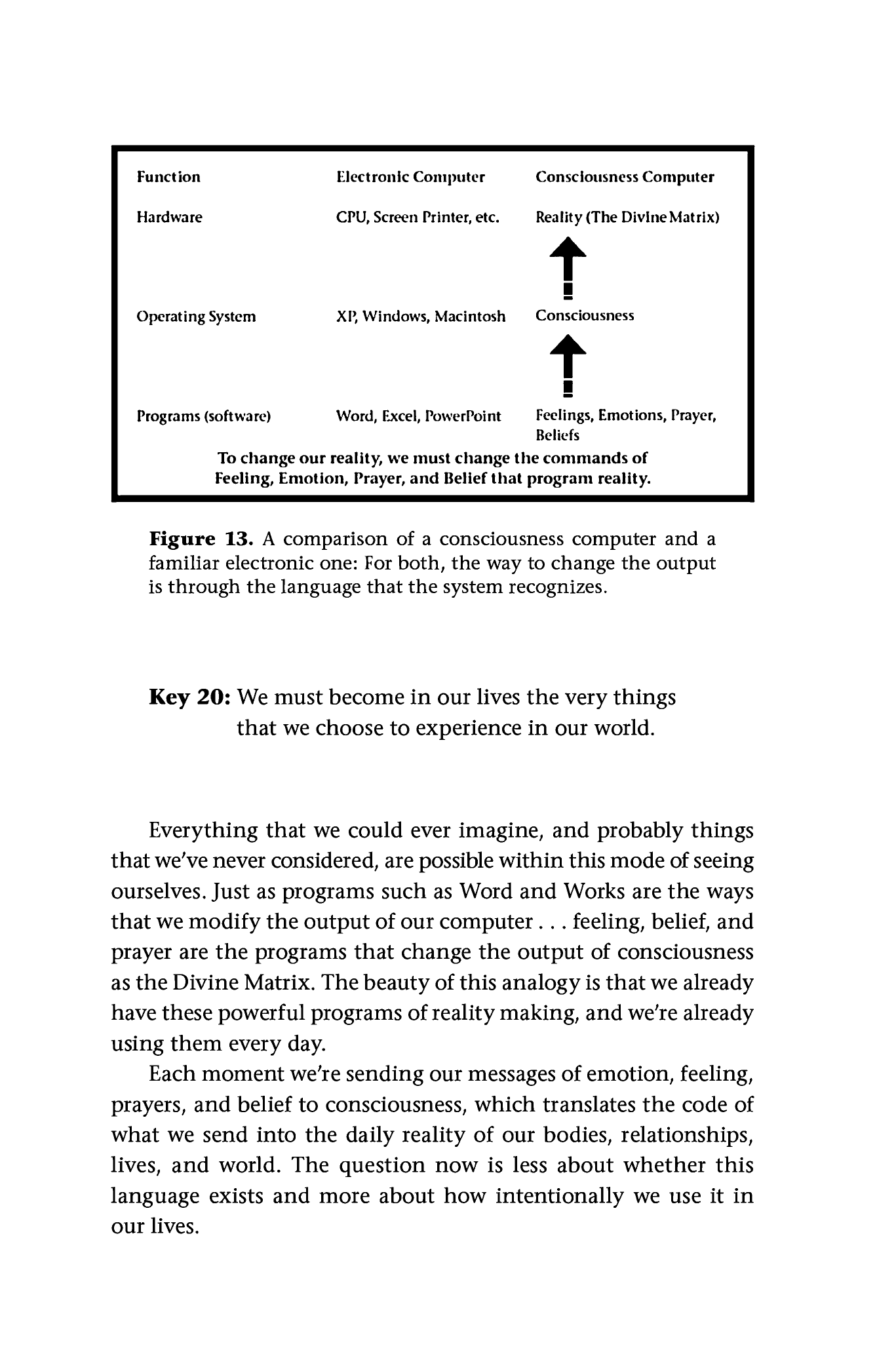
familiar electronic one: For both, the way to change the output is through the language that the system recognizes.
Key 20: We must become in our lives the very things that we choose to experience in our world.
Everything that we could ever imagine, and probably things that we’ve never considered, are possible within this mode of seeing ourselves. Just as programs such as Word and Works are the ways that we modify the output of our computer. . . feeling, belief, and prayer are the programs that change the output of consciousness as the Divine Matrix. The beauty of this analogy is that we already have these powerful programs of reality making, and we're already using them every day.
Each moment we're sending our messages of emotion, feeling, prayers, and belief to consciousness, which translates the code of what we send into the daily reality of our bodies, relationships, lives, and world. The question now is less about whether this language exists and more about how intentionally we use it in out lives.
To understand precisely why our beliefs are so powerful and how we make such a difference in a world of six billion or so people, we’ll take our understanding of the hologram one step further.
Patterns of the Whole
It should be obvious by now that we’re holographic beings. It ought to be equally apparent that we’re holographic bodies living in the holographic consciousness of a holographic universe. We're powerful beings expressing ourselves through the bodies that extend beyond the edge of our cells to become the universe itself. By simply “being” who we are, we encompass the whole of creation, mirroring everything from the largest phenomenon to the minutest occurrence, from the lightest of the light to the darkest of the dark. Our friends are part of that whole, as well as our partners, parents, and children. Our bodies mirror the patterns of the universe, embedded within more patterns, embedded within still more patterns, and so on. Our holographic existence is no secret, however, and has been the subject of some of the most profound and moving prose and poetry in the history of our world.
In the Gnostic work The Thunder: Perfect Mind, for example, a 3rd-century woman declares that she is nothing more and nothing less than the embodiment of all the possibilities that already exist within every person. “I am the first and the last,” she states. “T am the whore and the holy one. I am the wife and the
virgin. .. . 1 am the mother of my father and the sister of my husband. . . . In my weakness, do not forsake me, and do not be afraid of my power. .. . Why have you hated me in your
counsels?”
As accurately as these words may describe our holographic existence, they were written during the early years of the Christian church and were far ahead of their time. With this in mind, when the patriarchy of the church council was asked to choose which
documents would be omitted from the “official” religious texts, it’s easy to see why The Thunder: Perfect Mind was lost until the discovery of the pre-church Nag Hammadi library, nearly 1,700 years later.
What’s important here is that each of us is whole and complete unto ourselves. And in this state, we find the key to even greater patterns of healing that exist within an even greater wholeness. It’s this powerful principle that plays out in our lives, triggering experiences and emotions that may in fact have little to do with what we think they’re all about.
For example, there’s a good chance that the sadness we feel during a movie depicting loss has very little to do with the actual scene that’s portrayed in the movie. The riveting scene of soldiers shooting at the wolf tamed by John Dunbar (played by Kevin Costner) in the 1990 film Dances with Wolves is a perfect illustration of how this principle plays out in our lives. We watch through Dunbar’s eyes as the same soldiers who have taken him prisoner attack the wolf that has come to trust him as a friend.
I’ve seen this film on many occasions, and each time, the emotion that this scene elicits from the audience is powerful, genuine—and to some people, a mystery. Why do we feel so much sadness from seeing the wolf Two Socks hunted and killed? they ask. The answer might surprise them. The reason is because there’s a good possibility that the sadness they feel may have very little to do with what has just happened on the screen. There’s a good possibility that within the space of a few minutes, the movie has triggered feelings that they’ve locked away every time they’ve lost something precious or had it taken away from them.
Ultimately, it’s not surprising to discover that the feelings evoked while watching a film probably have more to do with us—what we’ve lost within ourselves to survive our experiences of life—than the people who are going through their drama in the movie. Without knowing that we’ve given so much of ourselves away, however, we may find ourselves reacting to the trigger of books, movies, or situations we identify with. This is our way of
reminding ourselves that we still recognize the things that we’ve lost in order to survive the hurtful moments of life.
Our lives seem to work this way: Each of us reflects for others different pieces of the whole. We're reminded of this in the ancient hermetic principle of “as above, so below; as within, so without.” As physicist John Wheeler suggested, we may be like cosmic feedback loops in the universe, with the same pattern repeating itself again and again, on different levels of scale. Taking this idea one step further, ancient traditions suggest that the “experience” loop of life continues for as long as it takes us to find our greatest healing. Then we're released from the cycle—or as Hindu beliefs affirm, our karma is complete.
Someone Must Do it First
In the living hologram of our consciousness computer, each and every piece of the hologram, no matter how small, lives within the realm of its own space. As such, it’s in service to a greater whole. The subatomic particles, for example, are what the atoms are made of and what determines how they work; the atoms, in turn, make up the molecules and dictate how they work; the molecules comprise the cells of our bodies and constitute how we work; and our bodies are a mirror of the cosmos... and so on.
Precisely because of the nature of a hologram, as we saw in Part II, a change on any level is reflected throughout the whole. Thus, it doesn’t take many people to anchor a new way of thinking or believing within the overall pattern of consciousness. From the Native Americans of the 15th century who learned to “see” the anomalous pattern of foreign ships after their tribal healer discovered how to change his sight, to the populations in Israel and Lebanon in the 1980s who experienced peace after individuals trained in a special way to feel peace did so at prescribed times, relatively few people creating a new program in consciousness can make a huge difference in the outcome of our collective reality. The key is that someone must do it first.
One person must choose a new way of being and live that difference in the presence of others so that it can be witnessed and sealed into the pattern. In doing so, we upgrade our programs of belief and send consciousness the blueprint for a new reality. We've seen this principle work many times in our past: From Buddha, Jesus, and Mohammed to Gandhi, Mother Teresa, and Martin Luther King, Jr., numerous individuals lived a new way of being in the presence of others. And they did so within the very consciousness that they chose to change. We may have heard about such powerful examples of change for so long that we take them for granted today.
A closer look at the way these masters have gone about seeding new ideas in an existing paradigm, however, is nothing short of astonishing. If we were to see such a thing in our computer analogy, it would be the equivalent of having our word-processing software suddenly reprogram itself to do rocket science . . . if such a thing happened, it would be the epitome of artificial intelligence! And that’s just about how miraculous it is for us to create a great change in the presence of the same beliefs that have limited us in the past.
That’s why it’s so powerful when we find a way to trust in a universe that gives us good reason to fear, find forgiveness on a planet that’s been entrenched in revenge, or find compassion in a world that has learned to kill what is feared or not understood. This is precisely what our master teachers accomplished. By living their wisdom, compassion, trust, and love, visionaries of our past changed the “software” of belief that was speaking to the “operating system” of consciousness. As the seeds of new possibilities, they “upgraded” our reality.
Today we have the same opportunity. We don’t have to be saints to make a difference. There’s an interesting distinction that makes our current choices different from those of our past. The scientific studies show that the more people there are who embrace a new belief, the easier it is to anchor that belief as a reality. (As mentioned in Part II, the “square root of one percent” equation simply demonstrates how many people it takes to begin
the change.) While Buddha, Jesus, and the other masters may have been the first to accomplish what they did, their examples proved to be the catalysts that opened the door for others to do the same. Even Jesus himself suggested that future generations would do what looked miraculous to the people of his day.
There have been many years and many people that have followed the lead of such visionaries, and the momentum of what they offered is the advantage that we have over the visionaries of our past. Today we know that we can heal our bodies and live to an advanced age. We know that love, appreciation, and gratitude are the life-affirming qualities that infuse our bodies with vitality and our world with peace. And we know that with the knowledge to upgrade what we say to the Divine Matrix, relatively few people can make a big difference.
So what do we do with such knowledge? What happens if one person decides on a new response to an old and hurtful pattern? What occurs if someone chooses to respond to “betrayal” or “violated trust,” for example, with something other than hurt and anger? What do you think takes place in a family when one member begins to watch the six o’clock news without feeling the need for revenge or to get even with those who have wronged and violated others? What happens is this: That single individual becomes a living bridge—both the pioneer and midwife—for every other person with the courage to choose the same path. Each time someone else makes the same choice, it’s a little easier because another person did it first.
As we discovered earlier, the key to their success is that in order to do so, they must transcend the things that hurt them without getting lost in the experience. In other words, Martin Luther King, Jr., couldn’t bring a stop to hate by hating. Nelson Mandela couldn’t have survived more than two decades in a South African prison if he had despised those who imprisoned him. In the same way, it’s impossible to end war by creating more wars. We've seen a powerful example of precisely this principle in our inability to find peace in the 20th century. Bottom line: In a universe that mirrors our beliefs, it’s clear that angry people can’t create a peaceful world.
We've tried, and the instability of the world today is the evidence of where our efforts have led.
In our examples of those who have changed the cycles of oppression from within the oppression itself, two powerful patterns emerge:
1. The choice to see beyond the hate originates from within the same system that spawns it, rather than being imposed upon the system from an outside source.
2. The people who make such a choice become the living bridge for those people they love the most. They find their truest power by living their truth in a system that doesn’t support their beliefs at the time.
What a powerful model! Holographic consciousness provides for a change made anywhere in the system becoming a change everywhere in the system. Even with six billion-plus people now sharing our world, we all benefit to some degree from the choices of peace and healing that are held by just a few. I can say that with certainty because we’ve witnessed this principle at work. Through our knowledge of the Divine Matrix, we now have everything we need to embrace our power to create and apply what we know to the great challenges of our time.
Whether we’re choosing peace in our world or within our families, healing in our loved ones or in ourselves, the principles are precisely the same. In our analogy of the universe as a consciousness computer with feelings, emotions, beliefs, and prayers programming reality, it makes perfect sense that we would have an instruction manual that highlights the steps of reality making. And we do: Through the ages, the most enlightened masters have shared it with us in bits and pieces. The keys in the next section, drawn from their teachings, are designed to lead us step-by-step through the sequence of logic and actions that’s been proven to create change.
While there are certainly other keys, this time-tested sequence
has been effective during history, as well as in my own experience. For that reason it’s offered here as an abbreviated “how-to” manual for upgrading our programs of reality and changing the world.
20 KEYS TO REALITY MAKING
Here are the keys that encapsulate the highlights of this book. Individually, they’re interesting. Collectively, they tell a story— our story—a reminder of our power to create. The keys may be considered as the software that our consciousness computer uses for reality making . . . our code of change. And as with any code, the keys are in a sequence for a reason. Simply put, just as we need to have all the ingredients in place before we begin to bake a cake, our keys to reality making work only if each step of the process is understood and available to us when we need it.
When I think about understanding these keys, I’m reminded of a powerful sequence of knowledge described in the mysterious third book of the Kabbalah, the Sepher Yetzirah. In the step-by- step instruction describing how the universe was made, the book’s unknown author invites the reader to consider each step of creation one at a time. In doing so, the reader gives each one the consideration of its own place of power. “Examine with them, / And probe with them,” the text says of the ancient instructions. “Make [each] thing stand on its essence.”*
Similarly, I invite you to consider the following sequence of keys individually. Allow each its own merit as a powerful agent of change. Work with it until it makes sense to you. Together, these steps can become your code for changing the world and yourself.
Key 1:
Key 2:
Key 3:
Key 4:
Key 5:
Key 6:
Key 7:
Key 8:
Key 9:
Key 10:
Key 11:
Key 12:
20 KEYS OF CONSCIOUS CREATION
The Divine Matrix is the container that holds the universe, the bridge between all things, and the mirror that shows us what we have created.
Everything in our world is connected to
everything else.
To tap the force of the universe itself, we must see ourselves as part of the world rather than separate from it.
Once something is joined, it is always connected, whether it remains physically linked or not.
The act of focusing our consciousness is an act of creation. Consciousness creates!
We have all the power we need to create all the changes we choose!
The focus of our awareness becomes the reality of our world.
To simply say that we choose a new reality is not enough!
Feeling is the language that “speaks” to the Divine Matrix. Feel as though your goal is accomplished and your prayer is already answered.
Not just any feeling will do. The ones that create must be without ego and judgment.
We must become in our lives the things that we choose to experience as our world.
We are not bound by the laws of physics as we know them today.
Key 13: Ina holographic “something,” every piece of the something mirrors the whole something.
Key 14: The universally connected hologram of consciousness promises that the instant we create our good wishes and prayers, they are already received at their destination.
Key 15: Through the hologram of consciousness, a little change in our lives is mirrored everywhere in our world.
Key 16: The minimum number of people required to “jump-start” a change in consciousness is the ¥1% of a population.
Key 17: The Divine Matrix serves as the mirror in our world of the relationships that we create in our beliefs.
Key 18: The root of our “negative” experiences may be reduced to one of three universal fears (or a combination of them): abandonment, low self- worth, or lack of trust.
Key 19: Our true beliefs are mirrored in our most intimate relationships.
Key 20: We must become in our lives the very things that we choose to experience in our world.
Almost universally, we share a sense that there’s more to us than meets the eye. Somewhere deep within the mists of our ancient memory, we know that we have magical and miraculous powers within us. From the time of childhood, we fantasize about our ability to do things that are beyond the realm of reason and logic. And why not? While we're children, we have yet to “learn” the rules that say miracles can’t happen in our lives.
The reminders of our miraculous potential are all around us. In Part II, I suggested that the “anomalies” of quantum particles could be something more than simply “strange” and “spooky” behavior. I asked if the freedom that these particles have to move in space- time is really showing us a freedom that might be possible in our lives. Intentionally, I’ve waited until now to answer that question. Following all of the experiments and research, along with the demonstration of those who have transcended the limits of their own beliefs, I believe that the answer is yes.
If the particles that we’re made of can be in instantaneous communication with one another, exist in two places at once, live in the past as well as the future, and even change history through choices in the present, then we can, too. The only difference between those isolated particles and us is that we’re made of a lot of them held together by the power of consciousness itself.
The ancient mystics reminded our hearts, and modern experiments have proven to our minds, that the single most powerful force in the universe lives within each of us. And that is the great secret of creation itself: the power to create in the world what we imagine in our beliefs. While it may sound too simple to be true, I believe that the universe works in precisely this way.
When the Sufi poet Rumi observed that we’re afraid of our own immortality, maybe he meant that it is actually the power to choose immortality that truly frightens us.
Just as Christopher Logue’s initiates in the Introduction discovered that all they needed was a little nudge to get them to fly, perhaps all we require is a little shift to see that we're the architects of our world and our fate, cosmic artists expressing our inner beliefs on the canvas of the universe. If we can remember that we’re the art as well as the artist, then perhaps we can also remember that we're the seed of the miracle as well as the miracle itself. If we can make that small shift, then we're already healed in the Divine Matrix.
Keep walking, though there's
no place to get to. Don’t try
to see through the distances.
That’s not for human beings.
Move within, but don’t move
the way fear makes you move.
— Rumi