The Universe Is Talking to Us: Messages from the Matrix
hile we speak to the Divine Matrix through the language of
feeling and belief, previous chapters also describe how the Matrix answers us through the events of our lives. In this dialogue, our deepest beliefs become the blueprint for everything that we experience. From the peace in our world to the healing in our bodies, from all our relationships and romances to the careers we pursue, our conversation with the world is constant and never ending. Because it doesn’t stop, it’s impossible for us to ever be passive observers on the sidelines of life . . . if we’re conscious, by definition, we're creating.
Sometimes the dialogue is subtle and sometimes not. Regardless of the degree of subtlety, however, life in a reflected universe promises that from our challenges to our joys, the world is nothing
more—or less—than the Matrix mirroring our deepest and truest beliefs. And this includes our intimate relationships. Although they present honest reflections, sometimes the mirrors we see of ourselves in other people can be the most difficult ones to accept. They can also be the fast track to our greatest healing.
OUR REFLECTED REALITY
In 1998, I had an experience in Tibet that offers a powerful metaphor for how the quantum “conversation” works. On the way into the capital city of Lhasa, our tour group was driving around a bend in the road that led to a small lake at the base of a cliff. The air was absolutely still, allowing the water to hold a perfect reflection of everything in the area.
From our vantage point, I could see the massive image of a beautifully carved Buddha mirrored in the water. Apparently, it was somewhere in the cliff overlooking the lake, although at that moment I couldn’t see the carving itself—all I could see was the reflection. It was only when we came around the curve and the road leveled out that I saw with my eyes what I’d imagined was the source of the reflection. And there it was: Sculpted in high relief, the Buddha towered above the lake, liberated from the living rock as a silent witness to all who passed.
In that moment, the image in the lake became a metaphor for the visible world. As we were coming around the bend and I saw the Buddha in the water, the reflection was the only way I knew that a statue existed. Although I suspected that it was mirroring something physical, from my perspective, I simply couldn’t see the object. In a similar way, the everyday world is said to be the reflection of a deeper reality carved into the fabric of the universe— a reality that we simply can’t see from our place within it.
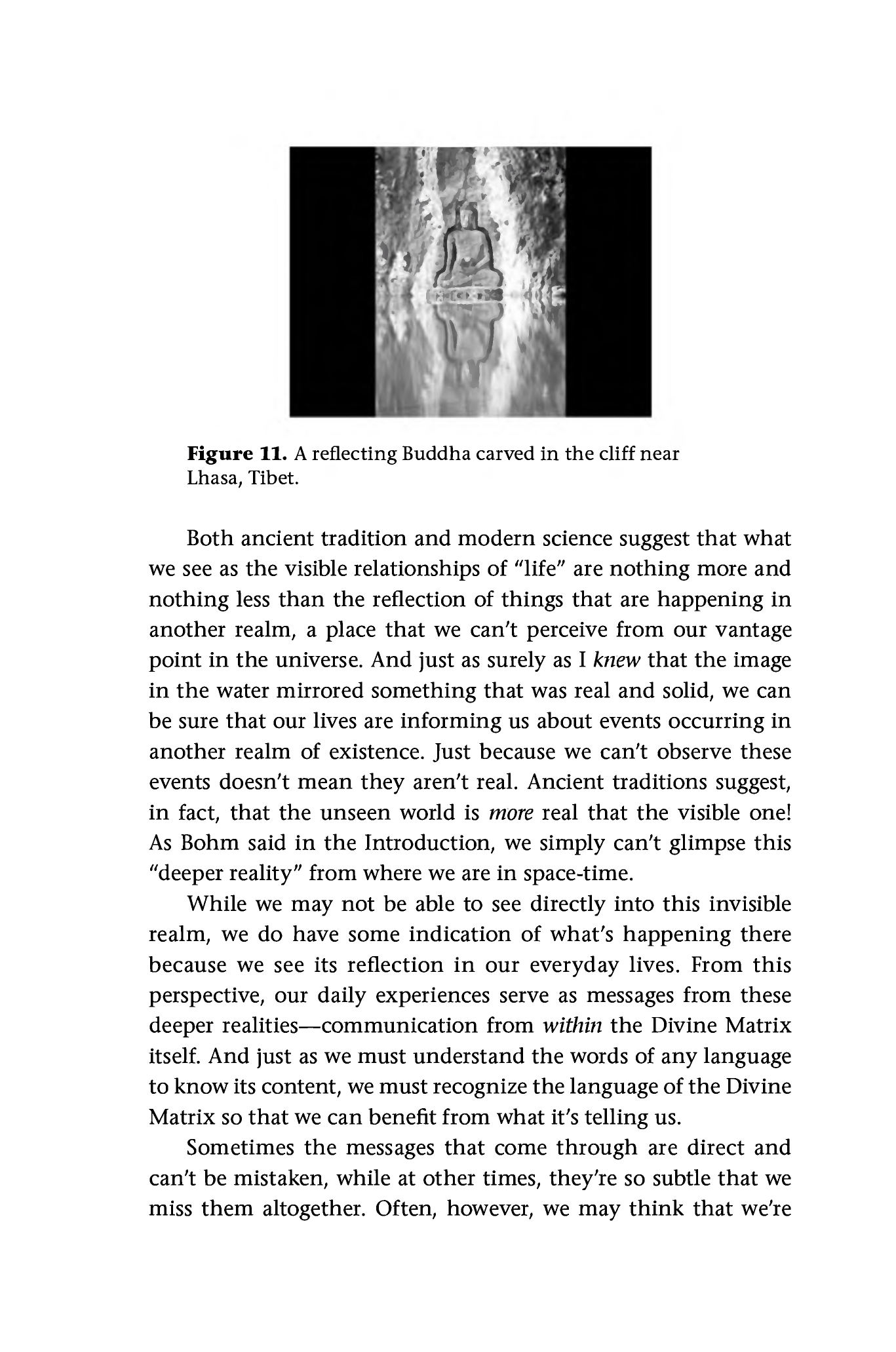
Lhasa, Tibet.
Both ancient tradition and modern science suggest that what we see as the visible relationships of “life” are nothing more and nothing less than the reflection of things that are happening in another realm, a place that we can’t perceive from our vantage point in the universe. And just as surely as I knew that the image in the water mirrored something that was real and solid, we can be sure that our lives are informing us about events occurring in another realm of existence. Just because we can’t observe these events doesn’t mean they aren’t real. Ancient traditions suggest, in fact, that the unseen world is more real that the visible one! As Bohm said in the Introduction, we simply can’t glimpse this “deeper reality” from where we are in space-time.
While we may not be able to see directly into this invisible realm, we do have some indication of what’s happening there because we see its reflection in our everyday lives. From this perspective, our daily experiences serve as messages from these deeper realities—communication from within the Divine Matrix itself. And just as we must understand the words of any language to know its content, we must recognize the language of the Divine Matrix so that we can benefit from what it’s telling us.
Sometimes the messages that come through are direct and can’t be mistaken, while at other times, they’re so subtle that we miss them altogether. Often, however, we may think that we're
being shown one thing when, in fact, the messages are telling us something very different.
Things Arent Always What They Seem
“A sudden gust of wind hit me at that instant and made my eyes
burn. I stared toward the area in question. There was absolutely nothing
out of the ordinary.
Tcan’t see a thing,’ I said.
‘You just felt it,’ he replied. |. . .]
‘What? The wind?’
‘Not just the wind,’ he said sternly. ‘Tt may seem to be wind to you, because wind is all you know.’
In this dialogue, the Yaqui Indian sorcerer Don Juan teaches his student Carlos Castenada about the subtle realities of the invisible world. In his book Journey to Ixtlan, Castenada, an anthropologist documenting the ways of the ancient shaman, learned very quickly that he couldn’t trust the filters of his perceptions as he’d been conditioned to do in the past. The world, he found out, is alive on levels that are both seen and unseen.
For instance, Castenada had always been taught that when the bushes move beside you and you feel cool air brushing against your cheek, it’s the wind that’s moving. In the example above, Castenada’s teacher reminds him that it only seems like the wind because that’s what he knows. In reality, it could be the wind, or the feeling of a breeze against his face and flowing through his hair may be the energy of a spirit making itself known. Castenada rapidly discovered that such an experience would never be “just the wind” again.
Through our filters of perception, we do our best to fit our romances, friendships, finances, and health into the framework that past experiences have established. Although these boundaries may work, how well do they really serve us? How many times have we responded to life in a way that we learned from someone
else, rather than based on what our own experiences have taught us? How often have we prevented ourselves from having greater abundance, deeper relationships, or more fulfilling jobs because an opportunity that crossed our path looked like a similar one from our past and we bolted in the opposite direction?
Were Tuned to Our World
Within the context of the Divine Matrix, we’re part of each blade of grass, as well as every rock in every stream and river. We're part of each drop of rain and even the cool air that brushes against our faces when we walk out of our homes first thing in the morning.
If our link to everything in our world runs so deep, then it makes sense that we should see evidence of that connection in our lives every single day. Maybe we do in fact see precisely such evidence—and maybe we see it every day, only in ways that we may not always recognize or even notice.
We all know that the longer we’re in the presence of the people, places, and things that surround us, the more we feel comfortable with them. For most of us, walking into the living room of our house, for example, certainly feels better than entering the “living room” of a hotel in another city. Even though the hotel may be newer and have all the latest fabrics, carpet, and upholstery, it just doesn’t feel like “home.” When we do experience something that way, our comfort comes from a fine-tuning of the subtle energy that brings us into balance with our world—we call that equilibrium resonance.
To some degree, we're in resonance with everything from our cars to our homes (and even the appliances that we rely on each day), which is why we affect other people, our surroundings, and our world simply by our presence. It should come as no surprise, then, that when something changes within us or the things around us, those changes will show up in our lives . . . and they do.
Sometimes these shifts come in ways that are subtle. For
example, I had an American-made car that had more than 300,000 miles on the original engine by the time I sold it in 1995. I’d always done my best to take care of my “old friend,” a reliable vehicle that looked like new and carried me safely from the mountains of Colorado to the hills of Napa, California, and back to the high desert of northern New Mexico.
While my car always started and ran perfectly for me, it never failed to “break down” whenever I loaned it to someone else. Invariably, a new noise would begin in the engine, a warning light would appear on the dashboard, or it would simply stop running when another person with a different touch took over as the driver. And just as certainly, when I would slip back into the driver’s seat and take it to the mechanic, the problem would just “heal itself,” mysteriously disappearing.
While the mechanic assured me that “these things happen all the time,” I’m sure that after a few such false alarms, he started to have second thoughts about me whenever he’d see my 300,000- mile Pontiac drive into his parking lot. While I can’t prove it scientifically, I’ve talked to enough other people to know that this isn’t an unusual experience. Things that are as familiar with us as we are with them simply seem to work better when they’re in our presence. Sometimes, though, our resonance with the world appears to us in a way that’s less subtle, with a message that’s harder to miss—such as in the following example.
In the spring of 1990, I had left my career in the defense industry in Denver and was living temporarily in San Francisco. During the daytime I was developing seminars and writing my first book, while at night I was working as a counselor. Specifically, I was providing guidance in understanding the power of emotion in our lives and the role that it plays in our relationships. One of my first clients described a relationship that was a beautiful example of just how deep—and how literal—our resonance with the world can be.
She described the long-term relationship with the man in her life as the “never-ending date.” For more than ten years, they’d been together in a relationship that appeared hopelessly
stuck. Their conversations about marriage always seemed to end in bitter disagreements, yet they didn’t do well apart from one another and wanted to share their lives together. One evening, my client described an experience of resonance that was so clear and powerful that it leaves little doubt that such a connection with our world exists.
“Tell me about your life this past week,” I said to her. “How are
things at home?”
“Oh, you wouldn’t believe the things that have happened,” she
began. “What a bizarre week! First, while my boyfriend and I were
watching TV on the couch, we heard a loud crash in the bathroom.
When we went to see what had happened, you'll never guess what
we saw.”
“T couldn’t begin to guess or even imagine,” I said, “but now
you've gotten me zeally interested . .. what happened?”
“Well, the hot-water pipe under the sink had exploded and
blown the door of the vanity off its hinges and into the wall in
front of the sink,” she answered.
“Wow!” I exclaimed. “I’ve never heard of anything like that in
my life.”
“That’s not all,” she continued. “There’s more! When we went
to the garage to get the car, there was hot water all over the floor—
the water heater had blown up and water was everywhere. Then,
when we backed the car out of the garage into the driveway, the
radiator hose on the car exploded, and there was hot antifreeze all
over the driveway!”
I listened to what this woman was saying and immediately recognized the pattern. “What was going on at home that day?” I asked. “How would you describe your relationship?”
“That’s easy,” she blurted out. “It had been like a pressure cooker
in that house.” Suddenly, she became quiet and just looked at me.
“You don’t think that the tension in our relationship has anything
to do with what happened, do you?”
“In my world,” I replied, “it has everything to do with what
happened. We’re tuned to our world, and the world shows us
physically the energy of what we experience emotionally.
Sometimes it’s subtle, but in your case, it was literal—your house literally mirrored the strain that you just described between you and your boyfriend. And it did so through the very essence that has been used for thousands of years to represent emotion: the medium of water. What a powerful, beautiful, and clear message you've received from the field! Now, what will you do with it?”
Key 17: The Divine Matrix serves as the mirror in our world of the relationships that we create in our beliefs.
Whether or not we recognize our resonant connection with the reality around us, it exists through the Divine Matrix. If we have the wisdom to understand the messages that come to us through our surroundings, our relationship with the world can be a powerful teacher. Sometimes it even saves our lives!
When the Message is a Warning
In my mother’s life, next to her two sons, her very best friend has been a 12-pound bundle of energy wrapped up in the body of a border terrier named Corey Sue (“Corey,” for short). While I travel frequently for tours and seminars, I do my best to call my mom at least once a week to check in and see how things are going in her life and let her know what’s happening in mine.
Just before my 2000 book tour for The Isaiah Effect, 1 called home on a Sunday afternoon, and Mom shared her concerns about Corey. She hadn’t been acting like herself or eating well, so my mother had taken her to a veterinarian to see if there was a problem. During the course of the examination, a series of x-rays were made, and they showed something that no one was expecting. For some unexplained reason, Corey’s films showed patches of small white spots throughout her lungs that shouldn't have been
there. “I’ve never seen anything like this in a dog before,” the mystified vet had said. The decision was made to run further tests to see what the spots might be indicating about Corey.
While Mom was obviously worried about her dog, as I listened to her story, I became concerned for another reason. I shared the principle of resonance with her and how we’re tuned to our world, our automobiles, our homes, and even our pets. I offered a number of case histories where animals have been documented to take on their owners’ medical conditions weeks or even months before the same problems were found in the bodies of the people who cared for them. My sense was that something similar was happening with Corey and my mom.
After some convincing that life is full of such messages, Mom agreed to get a checkup for herself the following week. Although she was experiencing absolutely no discomfort, and from outward appearances she had no reason to have an examination, she agreed to schedule a physical that included a chest x-ray.
Well, you can probably tell where this story is headed and the reason why I’m sharing it here. To Mom’s surprise, the x-rays revealed a suspicious spot on her lung, one that hadn’t been there during her annual physical less than a year before. After further investigation, my mother discovered that she had scar tissue on her right lung from an illness that had healed during her childhood, and the spot had become cancerous. Three weeks later, she underwent surgery and the lower third of her right lung was completely removed.
As J spoke with the doctor in the recovery room afterward, he reiterated how “lucky” Mom was that the mass had been detected early on, especially since there were no telltale symptoms to alert her to any problems. Prior to the surgery, she’d felt great and was going through life with Corey, her sons, and her beautiful gardens with absolutely no clue that anything might be wrong.
This is an example of how we can apply the mirrors in our lives. Because Mom and I had learned to read the messages that life was showing us in the moment and we trusted the language enough to apply it in a practical way, this story has a happy ending: Mom
recovered from her surgery. As of this writing, she’s doing great and has been cancer free for six years.
Interestingly enough, the spots in Corey’s lungs that had originally alerted us to investigate Mom’s condition completely disappeared after the surgery as well. She and Mom had another six years together in good health, with all of the joy that they found in each other and their daily routines.
(Note: Corey Sue left this world during the editing of this book due to complications of her advanced age. When she died, halfway to her 15th birthday, she was nearly 100 in “dog years” for her breed. She lived out the period after her spots and Mom’s surgery in good health and with a spark that brought joy to everyone whose life she touched. As Mom said many times, “No one was a stranger to Corey Sue.” She loved everyone she met and let them know it with a gentle wet kiss that will be missed by all who knew her.)
While it may not be possible to prove scientifically that Corey’s condition had anything whatsoever to do with what happened to my mother, we can say that the synchronicity between the two experiences is significant. And because this isn’t an isolated incident, we have to say that when we see such synchronicities, there is a correlation. While we may not fully understand the connection today, the truth is that we could study it for another 50 years and still not comprehend it completely. What we can do is apply what we know in our lives. When we do, the events of every day become a rich language that offers insights into our most intimate secrets.
Once again, in a world where life itself mirrors our deepest beliefs, there can be few things that are truly secret. Ultimately, it probably matters less how the unexpected curves in the road of life come our way, and more, whether or not we recognize the language that warns us of them.
OUR GREATEST FEARS
Because the Divine Matrix constantly reflects our beliefs, feelings, and emotions through the events of our lives, the everyday world provides insights about the deepest realms of our hidden selves. In our personal mirrors, we’re shown our truest convictions, loves, and fears. The world is a powerful (and often literal) mirror, one that isn’t always easy to face. With complete honesty, life gives us a direct window into the ultimate reality of our beliefs, and sometimes our reflections come to us in ways that we would never expect.
I remember an incident that occurred in the Safeway grocery store of a Denver suburb one evening in 1989. I’d stopped on the way home from work as I often did to pick up a few things for dinner. As I wandered along the canned-food section, I glanced up from my grocery list just long enough to notice that I was alone in the aisle, except for a young mother with a small girl seated in her shopping cart. They were obviously in a hurry and looked as if they were about as happy to be grocery shopping at the end of their long day as I was.
As my attention returned to comparing the names on my list to those of the cans on the shelves, I was suddenly startled by the sound of a child’s scream. This was not just any ol’ shriek: The volume and intensity would have rivaled Ella Fitzgerald’s “Is it live or is it Memorex?” commercials. The young girl was alone in the grocery cart, and she was terrified . . . absolutely terrified. Within a few seconds, the mother stepped into sight to calm her daughter down. Immediately, the child stopped screaming, and life returned to normal for everyone.
While we've all seen this before, something seemed different to me that night. For some reason, rather than simply ignoring such a common incident, I really took a look at what was happening. My eyes instinctively searched the aisle. All I saw was that the mother
had momentarily stepped away from her cart, leaving her two- to three-year-old daughter by herself for a moment. That was all—the girl was simply alone.
Why was she so frightened? Her mother had just walked away for an instant out of sight around the corner of another aisle. Why would a young child, surrounded by a world of colorful cans and pretty labels and with no one around to discourage any exploration, be so frightened by such a situation? Why wouldn’t she simply say to herself something along the lines of: Hey, here I am alone with these beautiful red and white cans of Campbell’s soup. I think I'll just explore each row, one can at a time, and have a great time doing it! Why would the prospect of being alone, even if only for a moment, touch something so deep in her at that early age that her instinct would be to scream at the top of her lungs?
On another evening, I’d scheduled a counseling session with a woman in her mid-30s I’d worked with many times before. Our appointment began as usual: As the young woman relaxed into the wicker chair in front of me, I asked her to describe what had happened during the course of the week since we'd last talked. She began telling me about her relationship with her husband of nearly 18 years. For much of the marriage they’d fought, sometimes violently. She’d been on the receiving end of what seemed like daily criticism of everything from the way she dressed to how she ran the house and cooked the meals. Even in bed she said that she felt as though she was never good enough.
While the treatment she described was nothing new in their relationship, during the past week the situation had escalated. Her husband had become angry when she confronted him with questions about his “overtime” and late nights at the office. She was miserable with the man she’d loved and trusted for so long. Now her misery was being compounded with the very real threat of physical harm resulting from her husband’s out-of- control emotions.
After knocking her to the ground in the heat of their most recent fight, her husband had left the house to go live with a friend. He provided no phone number, address, or indication of when or
if he’d come back—he was just gone. The man who’d made this womans life so miserable for so long and had threatened her safety with powerful outbursts of emotion and abuse was gone at last.
As she described his departure, I waited for some sign of relief. In its place, however, something astonishing started to happen. The woman began to sob uncontrollably with the realization that he was out of her life. When I asked her to describe how she was feeling, what I heard wasn’t the resolution or relief that I’d expected. Instead, she said that she was experiencing the pain of loneliness and longing. She began to describe feeling “crushed” and “absolutely devastated” in the absence of her husband. Now, with the opportunity to live free of criticism, insults, and abuse, she was distressed. Why?
The answer to “why” in the two situations I just described is the same. As different as each one is from the other, a common thread runs through both of these situations. There’s a very good chance that the terror that the young girl experienced in the supermarket aisle and the devastation felt by the woman whose abusive spouse walked out had little to do with the people who left them in those moments. The girl’s mother and the woman’s husband both served as catalysts for a subtle yet powerful pattern that runs so deep within each of us that it’s nearly unrecognizable ... often it’s completely forgotten.
That pattern is fear.
And fear has many masks in our culture. Although it plays a key role in the way we build everything from our friendships and careers to our romances and the health of our bodies, fear surfaces almost on a daily basis as a pattern in our lives that we don’t recognize. But interestingly, this pattern may not even be ours.
When we find ourselves touched by an experience that brings powerful negative emotions to the surface of our lives, we can rest assured that no matter what we think has caused fear to arise, there’s a good possibility that something different is being played out—something so deep and primal that it’s easy to overlook... that is, until it crosses our paths in a way that can’t be mistaken.
OUR UNIVERSAL FEARS
If you're reading this book, the chances are good that you’ve already examined the many relationships in your life. In your explorations, you’ve no doubt gained valuable insights into which people have triggered certain emotions and why. In fact, you probably know yourself so well that if I asked you questions about your life and your past, you could give me just the right answers to arrive at just the right conclusions for any therapeutic quiz that might be offered. And it’s in those perfect and acceptable answers that you may miss the single deepest pattern that’s permeated your life from the day you were born. It’s for this very reason that I invite seminar participants to complete a preprinted form asking them to identify the greatest patterns of their childhood caretakers that they would consider “negative.”
I ask for the negative patterns because I’ve rarely seen people trapped in the positive patterns of joy in their lives. Almost universally, the situations that cause people to feel stuck have roots in what are considered negative feelings. These are the emotions that we have about our own experiences and what they mean to us in our lives. And while we can’t alter what has happened, we can understand why we feel as we do and change what our life history means to us.
After completing the exercise, I ask the audience members to randomly shout out the characteristics that they’ve noted as negative qualities in both their male and female caretakers. In many people, these are their birth father and mother, while for others, they're their foster parents. To some, they’re older brothers, sisters, other relatives, or family friends. Regardless of who it is, the question relates to the people who cared for them in their formative years—that is, until about the age of puberty.
Any shyness in the room disappears as people begin to yell out the negative qualities from their charts as quickly as I can write them on a whiteboard. Immediately, something interesting begins to happen: As one person shares the word that describe his or her memory, someone else offers the same feeling and often even that
exact word. A sampling of the terms from any program shows nearly identical adjectives, including:
Angry Cold Unavailable — Critical
Judgmental Abusive Jealous Strict
Controlling Invisible Fearful Dishonest
There’s a lightness that begins to fill the room, and people start to laugh at what they’re seeing. If we didn’t know better, we’d think that we all came from the same family. The similarity of the words is more than coincidence. How can so many people from such diverse backgrounds have such similar experiences? The answer to this mystery is the pattern that runs deeply in the fabric of our collective consciousness, which may be described as our core, or universal, fears.
Universal patterns of fear may be so subtle in their expression yet so painful to recall that we skillfully create the masks that make them bearable. Similar to the way a difficult family memory is always there yet seldom discussed, we have unconsciously agreed to disguise the hurt of our collective past in ways that are socially acceptable. We're so successful in concealing our greatest fears that for all intents and purposes, the original reasons for our hurts are forgotten, and all that remains is their expression—that is, to act them out.
Just as the woman losing her husband or the young girl in the supermarket probably weren't aware of why they felt and reacted as they did, neither are we. Due to the ways we mask our fear, we never have to talk about the deepest hurts of our lives. Yet they remain with us, lingering and unresolved, until something happens and we can no longer simply look in another direction. When we allow ourselves to go a little deeper into these powerful, unmasked moments of life, what we discover is that as different as all our fears appear to be, they resolve into one of only three basic patterns (or a combination of them): the fear of separation and abandonment, the fear of low self-worth, and the fear of surrender and trust.
Let’s explore each one.
Our First Universal Fear:
SEPARATION AND ABANDONMENT
Almost universally there is a feeling that runs through each of us that we’re alone. Within each person and every family, there’s an unspoken sense that we’re somehow separated from whomever or whatever is responsible for our existence. We feel that somewhere in the mists of our ancient memory we were brought here and then abandoned without any explanation or reason.
Why would we expect to feel any differently? In the presence of the science that can place a human on the moon and translate our genetic code, we still don’t really know who we are. And we certainly don’t know for sure how we got here. We sense our spiritual nature from within, while we look to validate our feelings. From literature and cinema to music and culture, we make a distinction between our places here on Earth and a distant heaven that’s somewhere else. In the West, we affirm our separation from our Creator through our translation of the great prayer from the Bible that describes this relationship: The Lord’s Prayer.
For example, the common Western translation begins: “Our Father, who art in Heaven,” acknowledging this separation. In this interpretation, we're “here” while God is somewhere else far away. The original Aramaic texts, however, offer a different view of our relationship with our Heavenly Father. A translation of the same phrase begins, “Radiant One: You shine within us, outside us—even darkness shines—when we remember,” reinforcing the idea that the Creator isn’t separate and distant. Rather, the creative force of our Father—whatever the meaning we give to it—is not only with us, it is us and permeates all that we know as our world.
The 2004 discovery of the God Code and the message that comes from translating the DNA of all life into the letters of ancient Hebrew and Arabic alphabets seems to support this translation. When we follow the clues left to us in the 1st-century mystical book, the Sepher Yetzirah, we find that every one of the elements that compose our DNA corresponds to a letter from these alphabets. When we make the substitutions, we discover that the first layer
of DNA in our bodies does, in fact, seem to support the ancient admonition that a great intelligence resides everywhere, including within us. Human DNA literally reads: “God/Eternal within the body.”
When we have a fear in our lives, even if we aren’t consciously aware of precisely what it is, it creates an emotional bias in our bodies—an experience often described as a “charge” or a “hot button.” This shows up in our lives as the strong ideas we have as to something’s “rightness” or “wrongness,” or the way that a situation “should” play out. Our charges and hot buttons are the promise that we’ll create the relationships that show us which fear is asking to be healed. In other words, these charges will show us our fears—the greater one is, the deeper the fear. And they’re seldom wrong.
So, if you don’t consciously remember your fear of separation and abandonment, for example, there’s a good possibility that it will show up in your life in ways that you least expect and during the times that are the most inconvenient. In your romances, careers, and friendships, for instance, do you find that you're the “leaver” or the “leavee”?
Are you the one who’s always the last to know that the relationship is over? Do perfectly “good” marriages, jobs, and friendships seem to crumble before your eyes without warning and for no apparent reason? And are you devastated when these relationships break and fail?
Or maybe you're on the other side of this. Do you always leave your relationships, careers, and friendships while they’re still going strong just to avoid being hurt? Do you find yourself saying something such as: “This is the perfect ________ [fill in the blank]. I'd better quit now while things are good, before something happens and I get hurt.” If this kind of scenario has played out in your life or is doing so now, there’s a good possibility that it’s your masterfully created and socially acceptable way of masking your deepest fears of abandonment and separation.
By repeating these patterns in relationship after relationship, you may reduce the pain of your fear to a manageable level. It
might even get you through your entire life. The trade-off, however, is that the suffering turns into a diversion. It becomes your way of looking away from the universal fear that you were separated from the wholeness of your Creator, abandoned and eventually forgotten. How can you ever find the love, trust, and closeness that you long for if you're always leaving or being left behind just when you get close?
Our Second Universal Fear: Low Self-worth
Almost universally there is a feeling that runs through each person in every culture and society of our world that we are somehow just not good enough. We feel that we don’t deserve recognition for our contributions to our families, communities, and workplaces. We feel that we aren’t worthy of being honored and respected as human beings. Sometimes we even surprise ourselves with the feeling that we aren’t good enough to be alive.
While this sense of low self-worth may not always be conscious, it’s there continuously and provides the underlying foundation for the way we approach life and our relationships with other people. As masters of emotional survival, we often find ourselves playing out the real-life scenarios that equate to the imaginary values we place on ourselves.
For example, every one of us has dreams, hopes, and aspirations of accomplishing greater things in our lives, and more often than not we rationalize all the reasons why we'll never have them. As we've seen in earlier chapters, emotion is a language unto itself, the very language that the Divine Matrix responds to. When we feel as though we can’t achieve our biggest dreams, the Matrix simply gives back to us what we’ve given it to work with: delays, challenges, and obstacles.
Although we may wish for greater things, the doubt that comes from deep within us ultimately comes from our feelings of low worth. We wonder, Am I good enough to have such joy in my life? And why would we expect to feel any differently? In the Western
Judeo-Christian tradition, we’ve been told by those we trust and respect that we’re somehow “lesser” beings. We aren't as good as the angels of the heavens or the saints that we learn from. This same tradition has convinced many people that just by being in this world, we need to be redeemed from life itself for reasons that we're told are beyond our understanding.
Through the 2,000-year-old story of Jesus, we’re compared to the edited, condensed, and preferred memory of a man’s life that we can never live up to. Sometimes the comparisons are serious admonitions, suggesting that we may be condemned to a very tough afterlife if we don’t live a certain way. Sometimes they're a little lighter, simply reminding us of our inadequacy by asking sarcastic questions such as: “Who do you think you are—Jesus Christ?” or “How are you going to get there . . . walk on water?” How many times have you heard these or similar remarks, implying that even though you may try your best to live a good life, you’ll never be as good or worthy as a master of the past? Although we seldom take such comments seriously, on a deep level they still remind us that we’re somehow undeserving of life’s greatest joys.
Even if you have high self-esteem, to some degree you may believe these suggestions. Ultimately, on some level, we all probably do. As a result, we express our beliefs through our expectations of our achievements, how much joy we allow ourselves, and the success of our relationships. Our fear of not being valuable enough to have love, acceptance, health, and longevity promises that every one of our relationships will reflect the fear of low worth. And it happens in ways that we would never expect in a million years.
For example, how many times have you settled for relationships that aren’t what you really want but rationalized them by saying things such as: “This is good enough for now” or “This is a stepping- stone to something better”? Have you ever found yourself saying, “T'd love to share my life with a loving, compassionate, nurturing, and caring partner, but...” or “This isn’t the job where I can really express my gifts and talents, but . . .” followed by all the reasons why your greatest dreams can’t be realized in this moment?
If these or similar scenarios have played out in your life, there’s a good chance that they are the skillfully created masks that you use to question your worth. Through your personal and business relationships, you remind yourself of your core beliefs about yourself, beliefs that ask for a greater healing.
Our Third Universal Fear: Surrender and Trust
Have you ever experienced a relationship of any kind where your level of trust was so complete that you were able to surrender your individual self in exchange for knowing a greater one? To be clear here, I’m not suggesting that you give yourself and all of your personal power away in any situation. On the contrary, the experience that I’m asking about is one where you have such a strong sense of who you are that you allow yourself to let go of your beliefs about what or who you should be in exchange for a greater possibility of what you may become.
Almost universally there’s a feeling within each of us that it’s not safe to do so—it isn’t safe to trust other people, the wisdom of our bodies, or the peace of our world. And why should we think any differently? We need look no further than the evening news to give ourselves plenty of reasons to justify our feelings. Every day we're shown examples of behavior that seem to justify, and even perpetuate, the sense that we live in a frightening and dangerous world. From the terror, murder, and assaults that we see in the world at large to the violations of trust and betrayals that we experience in our personal lives and the myriad health concerns we're cautioned to watch for each day, this planet we call “home” certainly can look like a really scary place.
Ultimately, our sense of safety in the world must come from the security that we feel inside ourselves. To experience this, we must trust—we need to ask ourselves if we have faith in the intelligence of the universe that’s inherent in all situations and all life. If our answer to this question is no, then we must ask ourselves Why? Who or what experience taught us that our world isn’t safe and it’s not okay to trust?
Do you believe in the process of life, for example? When you find that the universe has thrown an unexpected curveball at you, a loved one, or a pet, do you immediately go to a place of blame so that you can feel protected? When your children walk out the door to go to school in the morning, do you worry that something might happen and they won't be safe, or do you know that they’re secure until you feel the joy of welcoming them home when the bus drops them off at 3:30 in the afternoon?
Although all of the frightening things that we see happening around us are certainly part of a reality, the key to overriding our fears is that they don’t necessarily need be part of our reality. While this may seem like a naive New Age philosophy, it’s actually a very ancient belief that’s now supported by leading-edge science. We know that the Divine Matrix exists, reflecting in our lives whatever we think, feel, emote, and believe in our hearts and minds. We're aware that a subtle shift in the way we see ourselves is all that’s needed for that change to be mirrored in our health, careers, and relationships. And this is where the preposterous nature of this vicious cycle of fear becomes apparent.
Key 18: The root of our “negative” experiences may be reduced to one of three universal fears (or a combination of them): abandonment, low self-worth, or lack of trust.
If we want something to change, we have to break the cycle and give the Matrix something different to reflect. Sounds simple, doesn’t it? It may be deceptively simple, since changing the way we see ourselves is probably the most difficult practice that we'll ever be faced with in our lives. Because of our inner beliefs, we experience in our outer world the grand battle that’s playing out within the hearts and minds of every person alive—the struggle that defines who we believe we are.
In the presence of all the reasons not to trust, we're asked to find a way out of the prison that our fear locks us into. Each day,
the experiences of life ask us to show ourselves how much we can trust... not simply to blindly trust for no reason, but to really feel the safety and security that are ours in the world.