Reading the Mirrors of Relationship: Messages from Ourselves
founder of Science of Mind
“The kingdom is inside of you,
and it is outside of you. . . .
There is nothing hidden
which will not become manifest.”
— Jesus's words, recorded by
Didymos Judas Thomas,
from the Nag Hammadi library
n addition to being the container for our experiences, the Divine Matrix provides the quantum mirror that shows us in our world what we've created in our beliefs. Through our relationships with other people, we're presented with the clearest examples of what those beliefs really are. Sometimes our mirrors are obvious, and we say, “So! That’s the way things work.” And other times they surprise us by reflecting the subtle reality of a judgment that’s very different from what we'd thought we believed. Regardless of what the mirrors teach us, it’s by spending time with others that they become the triggers for just the right emotions
and feelings at precisely the right times in our lives to help us heal our greatest hurts and deepest wounds. Our relationships show us our joys and loves, as well as our fears. But because we seldom become “stuck” in joy, purely pleasurable relationships are generally not the triggers for the profound lessons of life.
Relationships are our opportunity to see ourselves in every way imaginable. From the greatest betrayals of our trust to our most desperate attempts to fill our emptiness, everyone—including our co-workers, classmates, and life mates—shows us something about ourselves. If we have the wisdom to recognize the messages that are being mirrored to us, we discover the beliefs that cause the suffering in our lives.
I’ve met people who tell me that they’re taking a break from all relationships or will never be in another one because they find them too painful. The truth is that we’re always in a relationship with someone or something. Even if we live on a mountaintop and never see another human, we must still interact with that mountain and ourselves. In those interactions, we'll be shown the true reflection of our core beliefs. The reason? Our mirrors in the world never stop—they’re always working. There’s no escape! And the mirrors never lie.
Key 19: Our true beliefs are mirrored in our most intimate relationships.
The Divine Matrix provides a neutral surface that simply reflects what’s projected onto it. The question is whether or not we understand its language. Perhaps a better way to ask this is: Do we recognize the messages that we’re sending to ourselves as the Divine Matrix?
In the 20th century, Science of Mind founder Ernest Holmes stated, “Life is a mirror and will reflect back to the thinker what
he thinks into it.”! Numerous ancient traditions recognized this connection and valued the reflections of relationships as the path to wholeness and union with the Divine. In the Coptic, Gnostic, and Essene texts that were discovered as part of the Nag Hammadi library in 1945, for example, we're shown a series of mirrors that will face everyone at some point in their lives. Although they may always be present, it seems that there’s an order to the way we'll recognize them.
In these spiritual traditions, it was believed that as our painful feelings are healed, we master the patterns that allow the hurt to exist. In other words, to overcome the fear that may be in our lives today, we must first master the patterns that allow it to exist.
Five Ancient Mirrors of Relationship
The First Mirror: Reflections of the Moment
The Second Mirror: Reflections of What We Judge in the Moment
The Third Mirror: Reflections of What We’ve
Lost, Given Away, or Had
Taken from Us
The Fourth Mirror: Reflections of Our Dark
Night of the Soul
The Fifth Mirror: Reflections of Our Greatest Act of Compassion
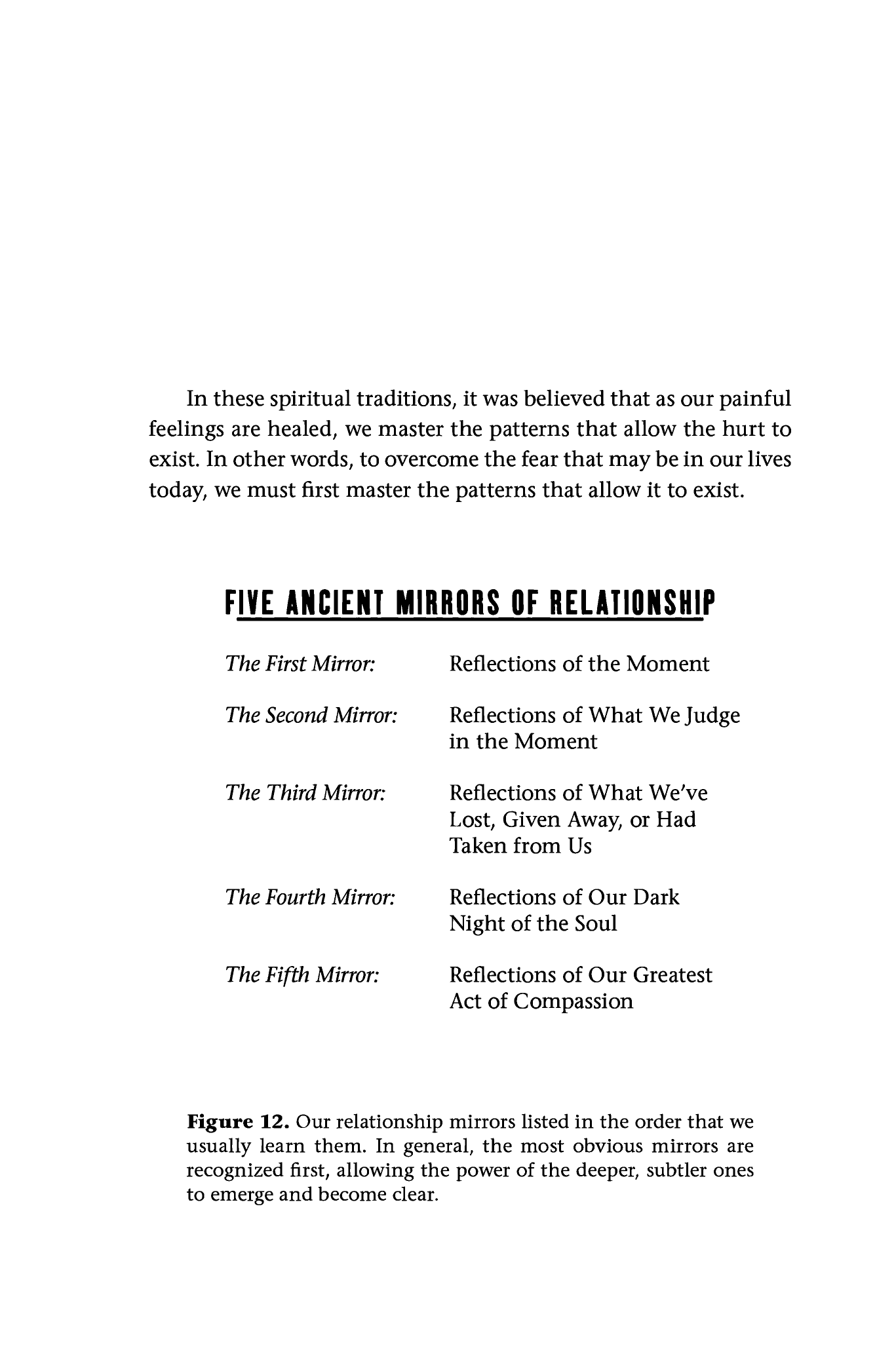
usually learn them. In general, the most obvious mirrors are recognized first, allowing the power of the deeper, subtler ones to emerge and become clear.
In the following sections, we'll explore the five mirrors of relationship from the most obvious to the most subtle. The resolution of each in sequence is the coded equation that allows for our greatest healing in the least amount of time. Scientific research has shown that as we change the way we feel about what’s happened to us in our past, we change the chemistry of our bodies in the present. Living in a universe where the way we feel about ourselves is mirrored through the world around us, it becomes more important than ever to recognize what our relationships are saying to us and learn to read the messages of the Divine Matrix.
THE FIRST MIRROR:
Reflections of the Moment
“You read the face of the sky and of
the earth, but you have not recognized
the one who is before you, and you do
not know how to read this moment.’?
— The Gospel of Thomas
Animals are great mirrors for triggering the subtle emotions that we call our “issues.” In the innocence of just being who they are, they can ignite powerful feelings of control and judgment about the way things should or shouldn’t be. Cats offer a perfect example.
My first experience with cats began in the winter of 1980. I was working for a petroleum company as a computer geologist and living in a small apartment in Denver. As a member of the newly formed technical-services department, I spent most of my days, evenings, and weekends learning the ins and outs of new computers and applying what I learned to the traditional concepts of petroleum geology. I hadn’t really considered owning any pets simply because I was never home enough to care for one.
One weekend a friend was visiting and brought me an unexpected gift: a beautiful orange and blond kitten about five
weeks old. He was the runt of the litter and named Tigger after the tiger in the classic Winnie-the-Pooh children’s books. Even though I wasn’t allowed to have a pet in my apartment, I was immediately drawn to Tigger and found that the big presence he carried in his small body added so much to my life that I missed him when he wasn’t there. Telling myself it could be only temporary, I decided to bend the rules a bit and keep him. And just like that, Tigger and I were a family.
Immediately, I trained my new friend to honor the “forbidden zones” in our home. He was taught to stay off of the couches, counters, and the top of the refrigerator. Above all, he couldn’t be perched in the windowsills for the world to see while I was at work. Each day I’d come home and he would be sleeping in one of our approved places. Everything seemed to be working out great with our secret relationship.
One day I came home from work earlier than usual. As I opened the door to my apartment, Tigger was awakened from a deep cat sleep right on the kitchen counter next to the sink—a spot we had definitely identified as being off-limits. He was as surprised to see me come through the door as I was to find him on the counter. Immediately, he jumped down, returned to his place on the bed, and waited to see what I would do. Now I was curious: Was this just a one-time incident, or was it an indication of what really happened when I left the house each day? Did he know my patterns so well that he would be in the right place at the right time just as I arrived home each evening?
That day I tried an experiment. Walking out to my balcony overlooking a beautiful greenbelt below, I slipped behind the drapes to hide and wait, pretending that I’d left for work. Within minutes, Tigger jumped from the bed and went directly into the kitchen. Believing that I was gone, he returned to his perch on the counter next to the toaster and the juice machine. He was so comfortable in this place that he began to nod off and was soon fast asleep next to the sink, somewhere he’d never go if he knew that I was home.
It was only when I spoke with friends who also had cats that I learned something probably every other owner of a feline has already discovered: You don’t train a cat! While there are certainly exceptions, generally cats do what cats do. They like high places and will gravitate to the highest ones—the same countertops, refrigerators, and windowsills that are forbidden zones. Although they may honor our rules while in our presence, when they’re alone, cats rule their own worlds.
The Mirrors Are Everywhere
The reason I share this story is because of what Tigger’s behavior “did” to me. In his simply being who he was, I found myself frustrated almost to the point of anger. He would look me directly in the eyes, and I knew that he was aware of precisely where his boundaries were. Still, he acted against his training and did what he chose to do, when he chose to do it.
Perhaps not coincidentally, during the time of my challenges with Tigger, I noticed parallels with frustrations in my job. In fact, it seemed as if the people I was supervising were doing to me exactly what Tigger was: They were disregarding my instructions for our projects. Following a particularly rough afternoon, one of my co-workers came up to me and asked why I simply didn’t just let her do her job. I had given her an assignment, and she felt that I was micromanaging her performance every step of the way. Later that evening, I walked into my apartment, and Tigger was in the forbidden zone of the kitchen counter once again. And this time when he looked at me, he didn’t even bother to move. I was furious!
As I sat on the couch to think about what I was being shown, I noticed the parallels between Tigger’s “disrespect” for my rules and what felt like the same attitude from my co-workers. Through two simultaneous although seemingly unrelated experiences, both Tigger and my co-workers had shown me something important about myself. Each had mirrored a pattern so subtle that I hadn’t
been conscious of it until that very moment. It was to become the first in a series of mirrors that I would have to recognize within myself before I could heal even more powerful and subtle ones in my other relationships.
During the 1960s and ’70s, it was common for self-help professionals to say that if we don’t like what the world is showing us, we should look at ourselves. They taught that everything from the anger of our co-workers to the betrayals of our trust is a reflection of our deepest beliefs. The patterns we identify with most strongly are often the ones we can’t even see in our lives. This scenario is precisely what was happening with regard to Tigger and the people at work.
I’m not suggesting that my co-workers were aware of how they were mirroring me or how this pattern was playing out in my life—I’m almost certain that they weren't. It’s simply that through the dynamics between us, I saw something about myself that they brought out in me. At that time in my life, it was the mirror of control. Because the reflection happened in the moment rather than hours or even days later, I could see the connection between my behavior and their reactions. Immediate feedback was the key to my lesson.
The Mirror of the Moment
We can see how important it is to recognize the relationship between what we do and what happens in the world if we look at the anthropological studies of hidden tribes in Asia. When explorers discovered one of the “lost” tribes (they were only lost to us, of course, as they knew precisely who they were and where they were located), they were surprised to find that the members made no connection between sexual intercourse and pregnancy. The lag time of months between the act of sex and the moment of birth was so great that the link between the two events wasn’t obvious to them. This is the value of our mirrors—their immediacy helps us understand the real, underlying connections between seemingly disparate events.
If we're seeing our beliefs play out through our mirrors, then they’re happening now. Any reflection we see affords us a precious moment of opportunity. Once it’s recognized, a negative pattern can be healed in a heartbeat! To recognize it is the first clue about why it exists. More often than not, we find that the negative patterns mirrored in our lives are rooted in one of the three universal fears we explored in the last chapter.
When we see out beliefs reflected in real time in our relationships with others, we experience the first of our mirrors, and it’s just that: the mirror of the moment. Sometimes, however, the reflection of the moment may be showing us something even subtler than what we're doing in our lives—sometimes it will reveal to us what we judge in our lives. When it does, we’re experiencing the second mirror of relationship.
THE SECOND MIRROR:
Reflections of What We Judge in the Moment
“Recognize what is in your sight,
and that which is hidden from
you will become plain to you.”
— The Gospel of Thomas
In the 1970s, one of my martial-arts instructors shared the secret of reading an opponent: “Each person in competition is a mirror to you. As your personal mirror, your opponent will show you who you are in the moment. By observing how he approaches you, you're seeing his reaction to how he perceives you.” Throughout my life, I’ve remembered my instructor’s words and thought about them often. Later on I began to apply what he had said about competition in the dojo to the way people behave in life. In 1992, I found myself embroiled in an experience where this mirror made no sense at all .. . it was then that I discovered the subtlety of the second mirror of relationship.
In the fall of that year, three new people came into my life within a very short period of time. Through them, I would experience three of the most powerful—as well as painful—trelationships that I’ve known as an adult. Although I didn’t recognize it at the time, each person would become a master teacher for me in a way that I never imagined he or she would or could. Together, they taught me the single lesson that assured me that my life would never be the same again. Even though each relationship served as a mirror for me at precisely the right time, I initially didn’t recognize what they were teaching me.
The first relationship was with a woman who had come into my life with such similar goals and interests to mine that we chose to live and work together. The second one was a new professional partnership that was to provide much-needed support for setting up and organizing seminars throughout the country. The third relationship was a combination of a friendship and business arrangement, which involved a man caretaking my property when I traveled for work in exchange for a place to live in one of my unused buildings that was under renovation.
The fact that these relationships came to me at the same time should have been my clue that something was up—something big. Almost immediately, all three began to test my patience, assertiveness, and resolve. I felt like these people were making me crazy! With each one, there were arguments and disagreements. Because | was traveling so much, my tendency was to discount the tensions and avoid looking for a resolution. I found myself taking a “wait-and-see” attitude until J returned from my next trip. When I did, things were always just the way I'd left them and sometimes even worse.
At that time, I had a routine that I followed when I came into the airport after each seminar. I would collect my gear from the baggage area, withdraw enough cash from the ATM for gas and a meal, and begin my four- to five-hour drive home. On one particular trip, however, something happened that brought everything in these relationships to a focus. After collecting my
bags, I went to the ATM to make my withdrawal. To my horror, the machine quietly printed a receipt that told me my account didn’t even have enough money for a $20 bill for gas!
This was especially horrifying, because I’d recently scheduled contractors to begin renovations on the 100-year-old adobe buildings on my property, and they’d just been paid with checks written on that very account. In addition to mortgage, office, travel, and family expenses, the machine was telling me that there was nothing—absolutely nothing—to cover any of my other obligations. J knew that it had to be a mistake. I also knew that at 5:30 p.m. on a Sunday afternoon in New Mexico nothing could be done—everything was closed until Monday. After convincing the lot attendant that I would repay the long-term-parking bill by mail, I began my extended drive home and thought about what had happened.
When I called my bank the next morning, I got even more of a surprise. To my disbelief, the zero balance was no mistake; there was truly nothing there. In fact, there was less than nothing—an unauthorized withdrawal by the woman IJ had entrusted with my business had completely emptied my account. Because of the penalties that had been applied to each one of the overdrawn checks, I also suddenly found myself with a negative balance caused by hundreds of dollars in overdraft charges.
I felt shock and disbelief. Quickly my emotions turned to anger, and then the anger became rage. My mind raced with the thoughts of all the people whom I’d written checks to and how I couldn’t honor those obligations. The violation of my trust and complete disregard for me and my commitments was more painful than I expected.
To make matters worse, later that day my business partnership reached a boiling point. As I opened my mail and looked over an accounting for seminars that I had already completed, I found discrepancies in the expenses, and soon I was on the phone fighting for my share of our proceeds, line item by line item.
During the same week, I discovered that the tenant living on my property was pursuing interests that were not only in direct
opposition to the agreements that we had made, but they were also frowned upon by the state of New Mexico. Clearly, I could no longer ignore what was happening in any of my relationships.
There's More Than One Mirror
The next morning, I walked down the dirt road leading away from my property to a large mountain that looms over the valley behind my home. In silent prayer, I stepped carefully over the deep mud ruts and broken gravel, asking for the wisdom to recognize the pattern that I was being shown so blatantly even though I couldn’t see it. What was the common thread that wove these relationships together? Remembering what my martial-arts instructor had said, I asked myself, What is the common reflection that these three people are showing me through their actions?
Immediately, words began to race through my mind, some so quickly that they disappeared, while others stood out clearly. Within seconds, four words emerged above all others: honesty, integrity, truth, and trust. I asked myself more questions: If these people are mirroring what I am in the moment, are they showing me that I’m dishonest? Have I somehow violated integrity, trust, and truth in my work?
As I asked the questions in my mind, a feeling welled up from deep within my body. Inside of me, a voice—my voice—was screaming, No! Of course I’m honest! Of course I have integrity! Of course I’m truthful and trustworthy! These things are the very basis of the work that I share with other people.
In the very next moment, another feeling came over me— fleeting at first, then clearer and stronger, until it was solidly present for me to see and know. In that moment, the mirror suddenly became crystal clear: The three people I had so skillfully drawn into my life weren’t showing me what I was in the moment; instead, each one of them was showing another, more subtle reflection that no one had told me about. Through our clashes of belief and lifestyle, rather than showing to me what I am, they were showing
me the things that I judge! These individuals were showing me the qualities that triggered a big charge in me—the very qualities that I felt they’d violated.
At that time in my life, I did have an enormous judgment on the way people held themselves accountable to the attributes of honesty and integrity. In all probability, my charge had been building since childhood. In a moment, my past experiences suddenly became clear. Immediately, I remembered all the times that these same qualities had been violated in my life: past romances in which my partners weren’t truthful about other people in our lives, adult promises that were made and never honored, well-intentioned friends and corporate mentors who’d made promises that they could never keep in a million years... my list went on and on.
My judgments regarding these issues had been building for years on such a minute level that I hadn’t even recognized them. Now they were at the core of something I couldn’t ignore! The magnitude of having an empty bank account was the assurance that J would have to understand the message of these relationships before I could move on in life. That was the day I learned the subtle yet profound mystery of the second mirror of relationship: the mirror of the things that I judge in life.
Do You Recognize Your Mirrors?
I invite you to examine your relationships with the people who are closest to you. Next, acknowledge the traits and characteristics that irritate you to no end and just seem to make you crazy. Once you do so, ask yourself the following question: Are these people showing me myself in this moment?
They may very well be. If so, you'll know it as your “gut” feeling immediately. However, if the answer is no, they may be revealing something even deeper and more powerful than the mirror of who you are—they might be showing you the reflection of the things that you judge in life. To simply recognize and acknowledge that the mirror exists is where the healing of your judgments begins.
Healing With the Cascade Effect
The day after I recognized the mirror of my judgments, I visited a friend who lives and works on the nearby Taos Pueblo. One of the oldest indigenous communities in North America, this site has been continuously inhabited for at least 1,500 years. Robert (not his real name) had a shop within the Pueblo itself and was a tremendously skilled artist and craftsman. Displayed throughout his store were the sculptures, dream catchers, music, and jewelry that had been part of his tradition for centuries before there was ever an “America.”
As I walked in, he was working on a sculpture nearly seven feet tall that was standing in the aisle beside him. After saying our hellos, I asked about his family and how business had been, and we enjoyed a few minutes of catch-up talk. He returned my questions, asking me what was happening in my life. I shared the events of the past week, the three people, and the missing money. After listening to my account, he thought for a few moments and then told me a story.
“My great-grandfather,” he began, “hunted buffalo on the
plains of northern New Mexico.” I knew that he must have been
talking about a long time ago, because as far as I knew, no buffalo
had roamed that part of the state for years. “Before his death, he
gave me his most valuable possession: the head of the first buffalo
that he ever hunted as a young boy.” Robert went on to tell me
how this buffalo head had become a treasure of his as well. After
his great-grandfather died, it was one of the few tangible relics that
connected him with the heritage of his past.
One day a gallery owner had come to visit Robert from the nearby town. Seeing how beautiful the head was, she asked if she could use it as part of a display in her gallery, and he had agreed. After a few weeks had passed, Robert hadn’t heard from his friend and went into town to see how she was doing. To his surprise, when he arrived at the gallery, nothing was there. The doors were locked, the windows were covered, and the shop was out of business. The gallery owner and his buffalo head were both gone. Robert looked
up from his sculpting long enough for me to see that he had been hurt in the experience.
“What did you do?” I asked. I expected to hear how he’d tracked
down the gallery owner and retrieved his prized possession.
As his eyes met mine, the wisdom of his answer was not lost in its simplicity: “I did nothing, because she lives with what she has done.” I left the Taos Pueblo that day thinking about the story and what it meant for my life.
Later that week, I began to explore the legal options for recovering at least some of the money that had disappeared from my account. I quickly learned that although I did have a good case, I was looking at a lengthy, drawn-out, and expensive process. Due to the nature of what had happened, I would be required to turn the case over to the authorities as a criminal, rather than a civil, matter. From that point on, it would be entirely out of my hands, and if convicted, the woman responsible could face prison time. All of this added up to a prolonged emotional relationship with someone whom I no longer felt any connection with.
As I thought about the options, I reflected once again on my conversation with my friend at the Pueblo and the lessons that had been learned. It didn’t take long for me to reach a conclusion that immediately felt right: I chose to do nothing. Almost immediately, something unexpected began to happen—each of the three people mirroring my judgments began to fall away from my life. I was no longer angry with them, and I no longer resented them. I began to feel an odd sense of “nothingness” with regard to each of these three people. There was no intentional effort on my part to drive them away. After I redefined what had happened between us for what the experiences were and not what my judgments had made them out to be, there was simply nothing left to keep those people in my life. Each one simply began to fade from my day-to-day activities. Suddenly, there were fewer phone calls and letters from them, along with fewer thoughts about them throughout the course of the day. My judgments had been the magnet that had held those relationships in place.
While this new development was interesting, within a few days, something even more intriguing and even a little curious began to occur. I realized that there were other people who had been in my life for a long time who also began to fade away. Once again, there was no conscious effort on my part to end these relationships; they just didn’t seem to make sense anymore. On the rare occasion that I did have a conversation with one of these individuals, it felt strained and artificial. Where there had been common ground before, now there was uneasiness.
Almost as soon as I noticed the shift in these relationships, I became aware of what for me was a new phenomenon. Each of the relationships that were falling from my life had been based in the same pattern that had originally brought the three people into my life... that pattern was judgment. In addition to being the magnet that drew the relationships to me, my judgment had also been the glue that had held them together. In its absence, the glue dissolved. I noticed what appeared to be a cascading effect: Once the pattern was recognized in one place—in one relationship—its echo faded on many other levels of my life.
The mirrors of judgment are subtle, elusive, and possibly won't make sense to everyone who becomes aware of them. When my friends and family heard of my decision to “do nothing,” they felt that I was in denial about what had happened. “She took your money!” they said. “She violated your trust! She left you with nothing!” On one level, their observations were true enough—all of those things had happened. My sense was that if I had followed the typical pattern of retribution and getting even, I would have found myself in the vicious cycle of thinking that feeds just such an experience. On another level, however, in simply being who they were, each of the three people showed me something about myself that would become key in the business decisions that I would make in the future. That something was a powerful lesson in the discernment of trust.
Prior to that time, I’d wanted to believe that trust is binary. That is, we either trust someone or we don’t—and if we do, we can trust
them fully. While I didn’t like to think of the world in another way, I had learned from these three relationships that there are levels of trust that we're left to discern in one another. Often we trust others to a greater degree and with more responsibility than they can even trust themselves. And this is just what I’d experienced.
The recognition of judgment reflected in a relationship is a powerful discovery that has reverberations that will touch every aspect of life. To the people who helped me with my lessons, I give thanks. And to those who showed me my humanness, I offer my deepest respect and gratitude for impeccably holding up the mirror before me. What a beautiful validation of the mystery of the second mizror of relationship!
(Note: In the previous story, I’ve alluded to reconciling the charge of judgment without fully describing precisely how that reconciliation may be accomplished. It is addressed fully in my 2006 Hay House release, Secrets of the Lost Mode of Prayer, as “The Third Secret: Blessing Is the Release.” To summarize this powerful key to transforming our judgments, blessing is the ancient secret that releases us from life’s suffering long enough to replace it with another feeling. When we bless the people or things that have hurt us, we’re temporarily suspending the cycle of pain. Whether this suspension lasts for a nanosecond or an entire day makes no difference. Whatever the period of time, during the blessing a doorway opens for us to begin our healing and move on with life. The key is that for some interval, we're released from our hurt long enough to let something else into our hearts and minds: the power of “beauty.”)
en —~_—_—____—_~~__-0
The Third Mirror: Reflections of
What We've Lost, Given Away, or Had Taken from Us
“The kingdom of the [father] is like a certain woman
who was carrying a [jar] full of meal. While she was
walking [on the] road, still some distance from home, the handle of the jar broke, and the meal emptied out behind her [on] the road. She did not realize it;
she had noticed no accident. When she reached her house, she set the jar down and found it empty.”
— The Gospel of Thomas
Your love, compassion, and caring are like the meal in the jar of the preceding parable. Throughout your life, they are the parts of you that comfort, nurture, and support others (as well as you) in the tough times. When we lose the people, places, and things that we hold dear, it’s our loving and compassionate nature that allows us to survive and get through those experiences.
Because we share them willingly, love, compassion, and caring are also the parts of us that are most vulnerable to being lost, innocently given away, or taken from us by those who have power over us. Each time we trust enough to love or nurture someone else and that faith is violated, we lose a little of ourselves to the experience. Our reluctance to expose ourselves again to such vulnerability is our protection—the way we survive our deepest hurts and greatest betrayals. And each time we shut off the access to our truest nature of compassion and nurturing, we're like the meal slowly leaving the jar that the woman is carrying.
When we do reach a point in life when we really want to open up and share ourselves with another person, we reach inside for our love, only to find that it’s gone and has left a reservoir of emptiness in its place. We discover that we’ve lost ourselves little by little to the very experiences that we trusted enough to allow them into our lives.
The good news here is that those parts of ourselves that seem to be absent are never really gone. It isn’t as though they’re obliterated forever ... they’re part of our truest essence, a part of our soul. And just as the soul can never be destroyed, the core of our true nature can never be lost. It’s simply masked and hidden for safekeeping. To recognize how we do the masking is to embark upon a fast path of healing. Calling back to us the parts of ourselves that we’ve lost may be the greatest expression of our personal mastery.
Early in my career in the defense industry, I worked as part of a team developing software for weapon systems. My colleagues and J shared a small work space in typical Air Force-regulation desks, chairs, and cubicles; and we spent long hours together in close proximity. As you can imagine, there was little privacy. As the phone conversations bounced from the stark Sheetrock walls and drifted over the tops of the cubicles, we got to know one another very well—so well, in fact, that we quickly became virtual advisors to one another for everything from career choices and dating options to family matters and personal lives.
Several times each week, we would go for lunch together, occasionally cashing paychecks and running quick noontime errands. It was during one of those lunch-hour adventures that I had the opportunity to see firsthand the mirror of an experience that created a personal “hell” in the life of one of my colleagues, a man who had also become a friend.
On any given day, my friend would “fall in love” with the women he met throughout the course of his business. It might be the server who had taken our order or the cashier at the checkout line of the grocery store. Honestly, it was almost anyone who crossed his path during the day (anyone female, that is). It happened everywhere, and the pattern was always the same: He would simply look into the woman’s eyes and “feel this feeling” that he couldn't explain. Without understanding what it was all about, he placed
his experience into the only explanation that he could find for what was happening. He felt that he was in love! And he fell in love many times each day.
The reason why this was such a problem was that he was matried. He had a beautiful wife who loved him very much and a beautiful new son, and he loved both of them tremendously. The last thing he would ever want to do was hurt them in any way or destroy what they’d created together. At the same time, his feelings for other women were nearly overwhelming and something that he simply didn’t understand.
On this occasion, we had just returned to the office following a quick lunch and gas-station/bank run. It was in the bank that he got into trouble. There was a beautiful teller working at the window where we deposited our checks. (This was in the old days before electronic deposits.) By the time we got back to the office, all he could do was think about her. He couldn’t work or focus, and he was unable to get her off his mind. “What if she’s thinking about me right now?” he asked. “What if she’s ‘the one’?” Finally, he picked up the phone, called the bank, found the teller, and asked if they could meet for coffee after work. She agreed. But while they were at the coffee shop, he looked into the eyes of the woman serving the drinks and fell in love with her!
I’m sharing this story because for reasons that he didn’t understand, this man was compelled to initiate contact with women he honestly believed he had feelings for. In doing so, he was risking everything that he held dear, including his wife, son, and career. What was happening to him?
Have you ever had a similar experience (although hopefully to a lesser degree)? Have you ever found yourself in a perfectly happy, committed relationship, and suddenly “it” happens? Or maybe you're not in a relationship or even looking for one, when—without warning—there you are walking down a busy street or in a mall, grocery store, or airport, and you have “the experience.” Someone you've never seen before passes you, in that instant your eyes meet, and—zing—there’s that feeling. Perhaps it’s just a sense of
familiarity or possibility, or it could be a nearly overwhelming impulse to stand close to this person, to get to know him or her, or even to initiate a conversation. I’ve asked about this many times in workshop situations. Interestingly, I’ve found that if we're really honest with ourselves, this kind of connection isn’t so unusual.
When it happens, the encounter commonly goes something like this: Even though two people’s eyes have met and they’ve obviously felt the “feeling,” one of them will discount the moment. For a brief fraction of a second, however, something undeniable happens . . . there’s an altered state and a sense of unreality. In that fleeting instant beyond the casual glance, their eyes communicate a message. Each person will be saying something to the other in that moment that probably neither is even aware of.
Then, almost as if on cue, their rational minds will create a distraction—anything to break the uneasiness of the contact. It may be the sound of a car or another person passing by. It can be as simple as a leaf blowing across the street, or a sneeze. It could even be sidestepping gum on the sidewalk! The point is that using anything for an excuse, one of the people will shift his or her attention, and the moment will be gone, just like that!
When we have such an experience, what has just happened?
Finding What We've Lost in Other People
When we find ourselves in these situations, we're faced with a powerful opportunity to know ourselves in a very special way— that is, if we recognize what the moment is all about. If we don’t, then, as my engineer friend discovered, this kind of connection can become confusing and even frightening! The secret of such encounters is the essence of the mystery of the third mirror.
To survive in our lives, we’ve all compromised huge parts of who we are. Each time we do so, we lose something inside in ways that are socially acceptable, yet nonetheless painful. Taking on adult roles and missing out on childhood following a family breakup; the loss of racial identity as cultures are forced together; and the
survival of an early trauma through repressing emotions of hurt, anger, and rage are all examples of losing pieces of ourselves.
Why would we do such a thing? Why would we betray our beliefs, love, trust, and compassion, knowing that they’re the very essence of who we are? The answer is simple: It’s survival. As a child, we may have discovered that it’s easier to remain silent, rather than voicing an opinion at the risk of being ridiculed and invalidated by parents, brothers, sisters, and peers. As the object of abuse in a family, it’s much safer to “give in” and forget, instead of resisting those who have power over us. As a society, we accept the killing of others during war, for example, and justify it as a special circumstance. We’ve all been conditioned to give ourselves away in the face of conflict, disease, and overwhelming emotion in ways that we're only now beginning to understand. In each instance, we have the opportunity to see a powerful possibility, rather than the judgment of what’s right and wrong.
For every piece of ourselves that we’ve given away to be where we are in life today, there’s the emptiness that’s left behind, waiting to be filled. We're constantly searching for whatever it is that fills our particular void. When we find someone who has the very things that we’ve given away, it feels good to be near him or her. The person’s complementary essence fills our inner void and makes us feel whole again. This is the key to understanding what happened to my engineer friend and in the other examples previously discussed.
When we find our “missing” pieces in others, we'll be powerfully and irresistibly drawn to them. We may even believe that we “need” them in our lives, until we remember that what we're so attracted to in them is something that we still have within us... it’s simply sleeping. In the awareness that we still possess those characteristics and traits, we may unmask them and reincorporate them back into our lives. And when we do, we suddenly find that we're no longer powerfully, magnetically, and inexplicably drawn to the person who originally mirrored those traits for us.
Recognizing our feelings toward others for what they are and not for what our conditioning has made them out to be is the key
to the third mirror of relationship. That unexplainable feeling that we have when we’re with someone else—that magnetism and fire that makes us feel so alive—is really us! It’s the essence of those parts of us that we've lost and our recognition that we want them back in our lives. So, with this in mind, let’s go back to the story of my engineer friend.
Certainly, there’s a good possibility that without knowing it consciously, my friend had seen in those women pieces of himself that he had lost, given away, or had taken from him throughout his life. There’s a good chance that he ran across them in men as well, but couldn’t allow himself to have the same feelings because of his conditioning. In his experience, the things that he lost were so prevalent that he found some trace of them in nearly everyone he met.
Not understanding what his feelings were all about, however, he was compelled to follow them in the only way he knew. He honestly believed that each encounter was an opportunity for happiness, because he felt so good while he was with the women. He still loved his wife and son very much—when I asked him once if he would ever leave them, he looked shocked. He had no desire to end his marriage, yet he followed the force of what he felt into compromising situations until the loss of his family became a very real danger.
How 10 Discover What Your Feelings
Of Attraction Are Telling You
Each of us has masterfully given away the portions of ourselves that we felt were necessary in the moment for our physical or emotional survival. When we do, it’s easy to see ourselves as “less than” and get trapped within our beliefs about what remains. For some people, the trade-off occurs before we ever know it, and we don’t realize what’s happened; for others, it’s a conscious choice.
One afternoon while I was working in the same defense corporation with my engineer friend, an unexpected invitation
landed on my desk. It was for an informal presentation that was to be made to White House and military officials for the newly funded weapon system named Strategic Defense Initiative (SDI), popularly referred to as “Star Wars.” During the reception that followed the event, I had the opportunity to listen in on a conversation between one of the high-ranking military officials and a CEO from our company.
The question that the CEO asked related to the personal cost the other man had incurred to be in his position of power. “What sacrifices did you have to make to get where you are today?” he asked. The official described how he’d risen through the ranks of the military and the Pentagon and into a position of authority with a large multinational corporation. I listened intently as the man answered with unusual candor and honesty.
“To get where I am today,” he began, “I had to give myself away
to the system. Each time I advanced in rank, I lost another piece of
myself in life. One day I realized that I was on top and looked back
at my life. What J discovered was that I’d given away so much of
myself that there was nothing left. The corporations and military
owned me. I'd let go of the things that I loved the most: my wife,
children, friends, and health. I traded those things for power,
wealth, and control.”
I was amazed by his honesty. Even though this man had admittedly lost himself in the process, he was aware of what he’d done. He was saddened, but to him it was a price worth paying for his position of power. Although probably not for the same reasons, we each may do something similar over the course of our lives. For many of us, however, the goal is less about power and more about survival.
When you do encounter someone in your life who ignites a feeling of familiarity, I invite you to immerse yourself in the moment. Something rare and precious is happening for both of you: You’ve just found someone who’s kept the pieces of you that you're searching for. Often this is a two-way experience, with the other person being drawn to you for the same reason! Using your power of discernment, if you feel that it’s appropriate, initiate a
conversation. Begin talking about anything—anything at all—to maintain eye contact. While you're speaking, mentally ask yourself this simple question: What do I see in this person that I’ve lost in myself, given away, or had taken from me?
Almost immediately, a response will come to you in your mind. It may be something as simple as a feeling of realization or as clear as a voice within that you recognize and that’s been with you since childhood. Answers are often single words or short phrases, and your body knows what’s meaningful for you. Maybe you simply perceive a beauty in this person that you feel is missing within you for the moment. Possibly it will be the individual’s innocence in life, the grace with which he or she moves down the grocery aisle, his or her confidence while performing the task at hand, or simply the radiance of his or her vitality.
Your encounter need last only seconds, perhaps a few minutes at most. Those brief instants are your opportunity to feel the joy and exhilaration of the moment. This is you finding part of yourself in another person, something that you already have, as well as the feeling of what it’s like to have that something awakened.
For those of us who dare to acknowledge the sense of familiarity in such momentary encounters, the mirror of loss is probably something that faces us every day. We find a completeness in ourselves as others mirror to us our truest nature. Collectively, we're looking for our wholeness, and we individually create the situations that lead us to find it. From members of clergy to teachers, older people to youthful individuals, parents to children, all are catalysts of feeling.
In those feelings, we find the things that we long for in ourselves, the things that are still with us yet are hidden in our masks of who we believe we are. It’s natural and human. Understanding what our feelings about others are really saying about us may become our most powerful tool in discovering our greatest power.
THE FOURTH MIRROR:
Reflections of Our Dark Night of the Soul
“That which you have will save you
if you bring it forth from yourselves.”
— The Gospel of Thomas
During the high-tech boom of the early 1990s, Gerald (not his real name) was an engineer in Silicon Valley, California. He had two beautiful young daughters and was married to an equally beautiful wife. They’d been together for nearly 15 years. When I met him, his company had recently given him an award for his fifth year with them as a senior troubleshooter for a specialized kind of software. His position had made him a valuable asset to the company, and the need for his expertise extended well beyond the typical 8-to-5 workday.
To meet the demand for his skills, Gerald began to work late evenings and weekends and travel to trade shows and expos out of town with his software. Before long, he found himself spending more time with his co-workers than he did with his family. I could see the hurt in his eyes as he described how they’d grown apart. By the time Gerald arrived home in the evenings, his wife and children were sleeping, and he was at his office in the morning before they even started their day. Soon he began to feel like a stranger in his own home. He knew more about the families of people in his office than he did his own.
That’s when Gerald’s life took a dramatic turn. He happened to come to see me for a counseling session while I was writing a book entitled Walking Between the Worlds: The Science of Compassion, describing how the “mirrors” of relationships play out in our lives. More than 2,200 years ago, the authors of the Dead Sea Scrolls identified seven specific patterns that we may expect to see in our interactions with other people. As Gerald’s story unfolded, it was clear that he was describing one of them, which is life’s reflection of our greatest fear, commonly known as the “Dark Night of the Soul.”
Among the engineers in his office was a brilliant young programmer who was about his age. He’d found himself teamed up with this woman for assignments that sometimes lasted for days at a time and took them to cities throughout the country. Before long, he felt as though he knew her better than he did his own wife. At this point in the story, I suspected that I knew where it would end. What I didn’t know was what happened next and why Gerald was so upset.
Before long, he believed that he was in love with his co-worker and made the choice to leave his wife and daughters to begin a new life with her. This decision made perfect sense at the time, as they had so much in common. Within a few short weeks, however, his new partner was transferred to a project in L.A. By calling in a few favors, Gerald was able to finagle a transfer to the same office.
Immediately, things began to go wrong, and Gerald found that he’d lost more than he’d bargained for. Friends that he and his wife had known for years suddenly became distant and unavailable. His co-workers thought he was “off the wall” for leaving the position and projects that he’d worked so hard for. Even his parents were angry that he’d broken up the family. Although he was hurt, Gerald rationalized that this was simply the price of change. He was off to a great new life. What more could he ask for?
This is where the mirror of balance and the Dark Night of the Soul come in. Just as everything appeared to be falling into place, Gerald discovered that everything was actually falling apart! Within weeks, his new love announced that their relationship wasn’t what she’d expected. She ended it suddenly and asked him to leave. Just like that, he was on his own, alone and devastated. “After all that I’ve done for her, how could she?” he moaned. He’d left his wife, children, friends, and job—in short, he’d surrendered everything that he loved.
Soon he began to perform poorly at his job. Following several warnings and a less-than-stellar performance review, his department eventually laid him off. As Gerald’s story unfolded, it was clear what had really happened: His life had gone from the highest of highs, with all the prospects of a new relationship, new
job, and greater income, to the lowest of lows, as all of those dreams disappeared. The night that Gerald came to see me, he was asking a single question: “What happened?” How could things that looked so good have turned out so bad?
Our Dark Night of the Soul:
RECOGNIZING THE TRIGGER
By the time I met him, Gerald had lost everything that he loved. The reason why is the key to this story. Rather than releasing the things he loved because he felt complete and was moving on, he made his choices only when he believed that there was something better to take their place. In other words, he played it safe. Because of his fear that he might not find anything better, he physically stayed with his marriage and family long after he’d left emotionally. There’s a subtle yet significant difference between leaving our jobs, friends, and romances because we’re complete and staying with them because of the fear that there’s nothing else for us!
There can be a tendency in all kinds of relationships to cling to the status quo until something better comes along. This attachment may come from being unaware of what we’re doing, or it may exist because we're afraid to rock the boat and face the uncertainty of not knowing what comes next. Although it may very well represent a pattern that we aren’t conscious of, it’s a pattern nonetheless. Whether it’s a job, aromance, or our lifestyle, we can find ourselves in a holding pattern where we aren’t really happy yet have never honestly communicated this to the people in our lives. So even while the world believes that our lives are business as usual, inside we may be screaming for change and feeling frustrated because we don’t know how to share this need with those who are close to us.
This is a pattern that builds negativity. Our true feelings are disguised as tension, hostility, or sometimes just being absent from the relationship. Each day we go through the motions of our
job or of sharing our life and home with another person, while we're emotionally distant and off in another world. Whether our problem is with a boss, a lover, or even ourselves, we rationalize, compromise, and wait. Then one day, just like that—boom!—it happens. Seemingly from out of nowhere, the very things that we’ve waited and longed for in our lives suddenly appear. When they do, we may lunge for them like there’s no tomorrow.
In Gerald’s case, when he moved to a new city with his new relationship, he left behind an unresolved void into which his world collapsed. Now, having lost all that he loved, Gerald sat across from me with huge tears rolling down his cheeks. “How can I get back my job and my family? Just tell me what to do!”
As I handed him the box of tissues that I kept on the nearby table for moments just like this one, J said something that caught Gerald completely off guard: “This time in your life isn’t about getting back what you've lost, although that may be just what happens. What you’ve created for yourself goes much deeper than your job and your family. You’ve just awakened a force within you that may become your most powerful ally. When you’ve come through this experience, you'll have a new confidence that’s unshakable. You’ve entered a time the ancients recognized and called the Dark Night of the Soul.”
Gerald wiped his eyes and sat back in his chair. “What do you mean the ‘Dark Night of the Soul’?” he asked. “How come I’ve never heard of it?”
“A Dark Night of the Soul is a time in your life when you'll be
drawn into a situation that represents what, for you, are your worst
fears,” I answered. “A time like this generally comes when you least
expect it, and usually without warning. The thing is,” I continued,
“you can only be drawn into this dynamic when your mastery of
life signals that you're ready! Then, just when it looks like life is
perfect, the balance that you’ve achieved is the signal that you're
ready for change. The lure to create the change will be something
that you long for in life, something that you simply can’t resist.
Otherwise, you'd never take the leap!”
“Do you mean a lure like a new relationship?” Gerald asked.
“Precisely like a new relationship,” I replied. “A relationship
is the kind of catalyst that promises we’ll move forward in life.”
I went on to explain how even if we know that we're perfectly
capable of surviving whatever life throws our way, it’s not our
nature to wake up one morning and say, “Hmm... . today I think
I'll give away all that I love and hold dear to enter my Dark Night
of the Soul.” We just don’t seem to work that way! As is so often
the case, the great tests of our Dark Night seem to come at a time
when we least expect them.
The possibility that life brings us exactly what we need precisely when we need it makes perfect sense. Just as we can’t fill a cup with water until we turn the tap to “on,” having a full emotional toolbox is the trigger that signals the faucet of life to bring on change. Until we trigger the flow, nothing can happen. The flip side of this dynamic is that when we do find ourselves in a Dark Night of the Soul, it may be reassuring to know that the only way we could have gotten to such a place in life is that we were the ones who flipped the switch. Knowingly or not, we’re always ready for whatever life may serve.
OUR GREATEST FEARS
The purpose of the Dark Night of the Soul is for us to experience and heal our own great fears. The really interesting thing about the Dark Night is that because everyone’s fears are different, what looks like a frightening experience for one person may be no big deal to someone else. For example, Gerald admitted that his worst fear was being left by himself. I’d spoken with a woman earlier the same evening who told me that “being alone” was her greatest joy.
It’s not uncommon for someone who fears being alone to become a master at relationships in which they’ll experience their fear. Gerald, for example, described romances, friendships, and jobs in his past that never could have lasted in a million years! Yet when each one ended, he believed that the relationship had “failed.” In reality, they were so successful that each allowed him to
see his greatest fear of being alone come to pass. Because he’d never healed or even recognized the patterns in his life before, however, he found himself in situations where his fear became less and less subtle. Ultimately, life led him to the point where this emotion was so present that he had to address it before he could continue.
While we may go through many Dark Nights of the Soul throughout our lifetimes, the first one is usually the toughest. It’s also frequently the most powerful agent of change. Once we understand why we hurt so much, the experience begins to take on new meaning. As we recognize the signposts of a Dark Night, we can say, “Aha! I know that pattern! Yup, it’s definitely a Dark Night of the Soul all right. Now, what is it that I’m being asked to master?”
I know people who are so empowered once they heal their Dark Night experiences that they almost dare the universe to bring on the next one! They do so simply because they know that if they’ve survived the first, they can survive anything. It’s only when we have such experiences without understanding what they are or why we're having them that we can find ourselves locked into years, or even lifetimes, of a pattern that can literally steal the very things from us that we hold most dear . . . such as life itself.
THE FIFTH MIRROR:
Reflections of Our Greatest Act of Compassion
“Show to me the stone which the builders
have rejected. That one is the cornerstone.”®
— The Gospel of Thomas
In the late 1980s, my office was in a huge multistory building in the foothills of Denver. Although the building was enormous, the end of the Cold War and cutbacks in government spending made it necessary for the company where I worked to “downsize”
and consolidate. As other divisions of the company moved into our facility, space was at a premium. I shared my office with another employee, a woman performing a function very different from mine within the department. There was no competition or shared responsibilities, and we quickly became good friends, exchanging stories of our family weekends, friends, and the joys and sorrows of life outside of the company.
One day, we’d just returned from lunch when she retrieved the messages that had come in on her voice mail while we were gone. From the corner of my eye, I saw her become very still and then sit down with a glazed look in her eyes. Her face turned pasty white except for the makeup on her lips and cheeks. After she hung up the phone, I gave her a moment to compose herself, then asked what had happened. She looked at me and began a story that I found sad and at the same time powerful.
A good friend of hers had a young daughter with a much- envied combination of beauty, athletic skills, and artistic talents, each of which she'd cultivated since early childhood. As the girl got older, she searched for a way to combine all of her attributes into a single career and chose to be a fashion model. Her family supported her decision and helped her in whatever way they could to fulfill her dream. As she shopped her portfolio to the ad agencies, she found that many responded with enthusiasm. She had offers of travel, education, and more support than she could have imagined. To everyone looking in from the outside, her life couldn’t have seemed better.
On a subtle, almost imperceptible level, however, those who really knew her could see that something was changing. Her enthusiasm was giving way to concern. The agencies she was working with were searching for a certain kind of look in the women they would promote. While this young girl certainly had a unique beauty, it wasn’t quite what the agencies wanted in the late '80s. Haunted by what it took to get that special something, the young girl asked her family to help her with a series of cosmetic procedures that she felt would mold her body into what the industry was searching for.
She began with the most obvious enhancements, nips, and tucks. While bringing her closer to her goal, she still didn’t have quite the “look” and began even more extreme procedures. Since childhood she’d always had a slight overbite, with her chin and jaw recessed slightly. She agreed to a restructuring that involved breaking and resetting her jaw to create better symmetry. Her mouth had been wired shut for about six weeks while the bones healed, and she’d eaten only liquids during that time. Afterward, the wires were removed, and she did have a beautifully symmetrical face with accentuated cheekbones, and the overbite was gone. Looking at a photograph that my office mate had of her friend’s daughter, I personally could see little difference between the before- and after- surgery images.
Having lost weight from weeks of being on a liquid diet, this beautiful young woman began to notice that her body no longer had the V shape that it had before the surgery. The reality was that due to her weight loss, her upper body had lost the muscle tone that had given her the “model” proportions. Her perception, however, was that there was a problem that could be surgically remedied, and she underwent a procedure to remove her lower “floating” ribs in order to acquire greater definition and proportion.
The stress from all of her procedures put her body into a tailspin. She discovered that she could no longer control the addition or loss of a pound here and there. Her body was in a “lose-weight” mode and she was losing on a daily basis. By the time her parents recognized what was happening and hospitalized her, it was too late: Attributed to a series of complications rather than any one thing, my office mate’s friend had passed away that morning. That was the phone message she received after lunch.
You may know people on a similar path, although hopefully a less extreme one. I use this example to emphasize a point. The young woman in this story had an image of perfection in her mind's eye, and that image became her standard of comparison. She constantly held herself in the shadow of that point of reference, using her mental image as the measure of comparison for her physical appearance. Her beliefs said that she was somehow
imperfect the way she was, and that her “imperfections” could be fixed through the miracle of modern technology. What happened to this woman, however, runs much deeper than the procedures used to fix her perceived flaws—it goes directly to the heart of this mirror.
Why did the woman feel that such extremes were necessary for her success? Why did her family and friends support her in her drive for perfection? Why did this young person, already beautiful in her own right, feel so compelled to become something other than who she was from the time of her birth? What fear (or fears) became so powerful in her life that she tried to change her appearance to meet the approval of others? Perhaps an even greater question is: What can we learn from her experience? What do we use as our yardstick of comparison? What is the point of reference that we hold ourselves accountable to as we gauge our own successes and failures in life?
THE “IMPERFECTIONS” ARE THE PERFECTION
loften share this story in my workshops. Immediately afterward, I'll ask participants to complete a simple chart, where they evaluate themselves in areas such as educational, romantic, professional, and athletic accomplishments. The rating system is made up of four categories that range from “really good” to “really bad.” The key here is that I give them very little time to complete the forms. And I do this for a reason: The actual response on paper is less important than the thinking that goes into it.
Whatever the answers, the reality is that anything less than perfect is a participant judging him- or herself. The only way that people can possibly rate themselves as a success or failure is by comparison to something outside of their experience. As we all know, we are our own toughest critics. For this reason, this mirror is known as our greatest act of compassion. It’s about compassion for ourselves—what we are and who we’ve become.
It’s through the mirror of ourselves that we’re asked to allow
compassionately for the perfection that already exists in each moment of life. This is true regardless of how others see that moment or how it actually turns out. Until we attach a significance of our own making to the outcome, each experience is simply an opportunity to express ourselves . . . nothing more and nothing less.
How would your life be different if you allowed everything you do to be perfect just the way it is, regardless of how it turns out? If everything we do and create is done to the best of our ability, then until we compare it to something else, how can it be anything less than great? If a professional project, relationship, or school assignment doesn’t turn out the way that was expected, we can always learn from our experiences and do things differently the next time around. In the Divine Matrix, it’s the way we feel about ourselves—our performance, appearance, and achievements— that’s mirrored back to us as the reality of our world. With this in mind, the deepest healing of our lives may also become our greatest act of compassion. It’s the kindness that we give ourselves.
BEYOND THE MIRRORS
While there are certainly other mirrors that show us even subtler secrets of our truest nature, the ones that I’ve offered here are the five mirrors that allow our greatest healing in the relationships of life. In this process, we find our truest power as creators in the Divine Matrix. Each mirror is a stepping-stone toward a greater level of personal mastery. Once you know about them, you can’t “un-know” them. Once you see them play out in your life, you can’t “un-see” them. Each time you recognize one of the mirrors in a particular place in your life, there’s a good possibility that you'll find the same pattern playing out in other areas as well.
The control issues that bring up so much emotion with your family at home, for example, may surface with much less intensity while bargaining for a used car with a stranger. The reason it’s
more moderate is because you probably don’t have the same level of intimacy with the salesperson as you do with your family and friends. Although the patterns are less intense, they’re still there. And this is the beauty of the holographic pattern of consciousness. The resolution that you find in your relationship with the car dealer, the grocery-store checkout clerk, or the server who brought you a burned dinner at your favorite restaurant will trickle into your relationships at home. It must, because that’s the very nature of the hologram. Once a pattern changes in one place, every relationship that holds the same pattern will benefit.
The changes sometimes come to us in the places we least expect. If they didn’t, we would probably never get up in the morning and say, “Today I'll tackle the relationships that show me my greatest mirrors of my deepest judgments.” We just don’t seem to work that way! Instead, our opportunities to heal through our mirrors often come while we’re on the way to the mailbox or putting air in the tires of our car.
Not long ago, I met a friend who’d just given up a career, family, friends, and a relationship in another state to move to the wilderness of northern New Mexico. I asked him why he had left so much behind to live in the isolation of the high desert. He began telling me that he’d come to find his “spiritual path.” In the same breath, however, he told me that he hadn’t been able to get started because nothing was going right. He was having problems with his family, business plans, and even the contractors who were building his new “spiritual” home. His frustration was obvious. Listening to his story, I offered the one insight that I felt might help.
From my perspective, we're incapable of anything other than a spiritual life. To put it another way, as beings of spirit, we’re capable only of spiritual experiences. Regardless of what life may look like, I believe that each endeavor and all our paths are leading us to the same place. From that belief, the activities of every day can’t be separate from our spiritual evolution—they are our spiritual evolution!
I turned to my friend and suggested that just perhaps all
of the challenges that were in his life at the moment were his spiritual path. While this was obviously not the answer that he’d expected, he was curious about what I meant. He had an idea that his spirituality would be realized by living in solitude and quiet contemplation each day.
I clarified my beliefs, suggesting that although all these things may become part of his life, the way he would resolve each of the challenges facing him could be precisely the path that he’d come to explore. Glancing back at me with a surprised look on his face as we said our good-byes, he simply replied, “Maybe it is!”